


Heart Color Meanings: What Every Heart Emoji Says

If you’re searching for heart color meanings, you’ve probably received a colored heart — yellow, blue, purple, black — and wondered what the sender actually meant. Here’s the thing most people miss: heart colors aren’t random decoration. Indeed, over years of texting culture, each color has developed its own emotional dialect. As a result, send the wrong one and your message lands differently than you intended — send the right one and you say exactly what you feel without typing a word.
For instance, this guide decodes every major heart color meaning — from the romantic red to the platonic yellow, the loyal blue, the supportive purple, the mysterious black, and the pure white — plus the special hearts (broken, beating, growing, sparkling), a quick-reference chart, and practical rules for choosing the right heart for every relationship.
Did someone send you a 💛 and you’re wondering if it means friendship or something more? Are you choosing between 💙 and 💜 for a message that matters? Or do you just want to stop second-guessing every heart you receive? You’ll get all three answers here.
Heart Color Meanings: How to Read This Guide
Before the colors themselves, one essential truth: heart colors are emotional cues, not rules. No color has an official definition — meanings emerged from millions of people using them in context, and context still matters more than color. For example, a 🖤 from your goth friend means something different than a 🖤 in a condolence message.
That said, strong conventions do exist, and knowing them prevents most misunderstandings. As you read, keep three principles in mind. First of all, red is the default for romance — every other color exists partly to say “this isn’t quite red.” Second, habit often beats symbolism — many people use their favorite color regardless of meaning, so don’t over-read a single heart. Third, when a message matters, words beat emoji — a heart colors the tone, but it can’t carry the whole message.
For a detailed reference on each heart’s usage, Quillbot’s heart emoji guide breaks down every color with examples — a useful companion to this guide.
Next, let’s go color by color, grouped by the feelings they carry.
Romantic Heart Colors
These are the hearts of love — from deep romance to new sparks.
Red: The Classic of Romance
First, the red heart ❤️ means romantic love, deep affection, and strong emotional connection. Indeed, it’s the original, the default, the one every other heart is measured against. Sending red says “I love you” in the fullest sense — which is exactly why it’s also the riskiest heart to send casually.
Similarly, use red for partners and for the closest family and friends where the love is unambiguous. Avoid it with acquaintances, colleagues, or new connections unless you mean it — because they will read it as romance.
Pink: Sweet and Playful
Next, the pink heart 🩷 means gentle love, sweetness, and playful affection. In other words, it’s romance with the intensity turned down — tender rather than passionate. For example, think new crushes, affectionate friendships with warmth, and messages that feel like a smile.
If red feels too serious for where things stand, pink is often the perfect middle ground.
Heart on Fire: Burning Passion
Then there’s the heart on fire ❤️🔥, which means intense passion, desire, and burning love. In short, it’s red with the volume at maximum — lust, infatuation, the early blaze of something consuming. Use it when “I love you” doesn’t cover the heat.
Friendship Heart Colors
The hearts that say “you matter to me” without saying “I’m in love with you.”
Yellow: The Friendship Classic
The yellow heart 💛 means platonic love, friendship, happiness, and warmth. In fact, it’s the most established “not-romantic” heart — on Snapchat, it even marks your #1 Best Friend. Yellow, in other words, says “you’re important to me” with sunshine rather than fire.
As a result, this is your safest choice for friends — and the one most likely to be read exactly as intended. When in doubt between red and anything else, yellow is usually the answer.
Orange: Warm and Supportive
Similarly, the orange heart 🧡 means friendly care, warmth, and emotional support. Softer than yellow, warmer than blue — it’s the heart of “thinking of you” and “I’m here for you.” It carries care without any romantic charge, making it ideal for comforting someone or showing steady friendly affection.
Blue: Loyalty and Trust
The blue heart 💙, meanwhile, means loyalty, trust, and stable, dependable affection. It’s the heart of long-term bonds — the friend who’s always there, the team that feels like family, the quiet confidence of “I’ve got you.” Blue can also signal calm support without emotional intensity.
Many people choose blue for friendships specifically because it feels warm without borrowing red’s romantic weight.
Green: Growth and Good Vibes
The green heart 💚 means growth, health, harmony, and nature — and, by extension, friendship rooted in shared values. For instance, it’s the heart of wellness journeys, environmental causes, and supportive communities (it’s famously the NCT K-pop fandom color). Green can also carry a playful hint of jealousy in romantic contexts — “green with envy” is old slang, after all.
Use green when the bond involves growth, health, or a shared cause.
Support and Depth Heart Colors
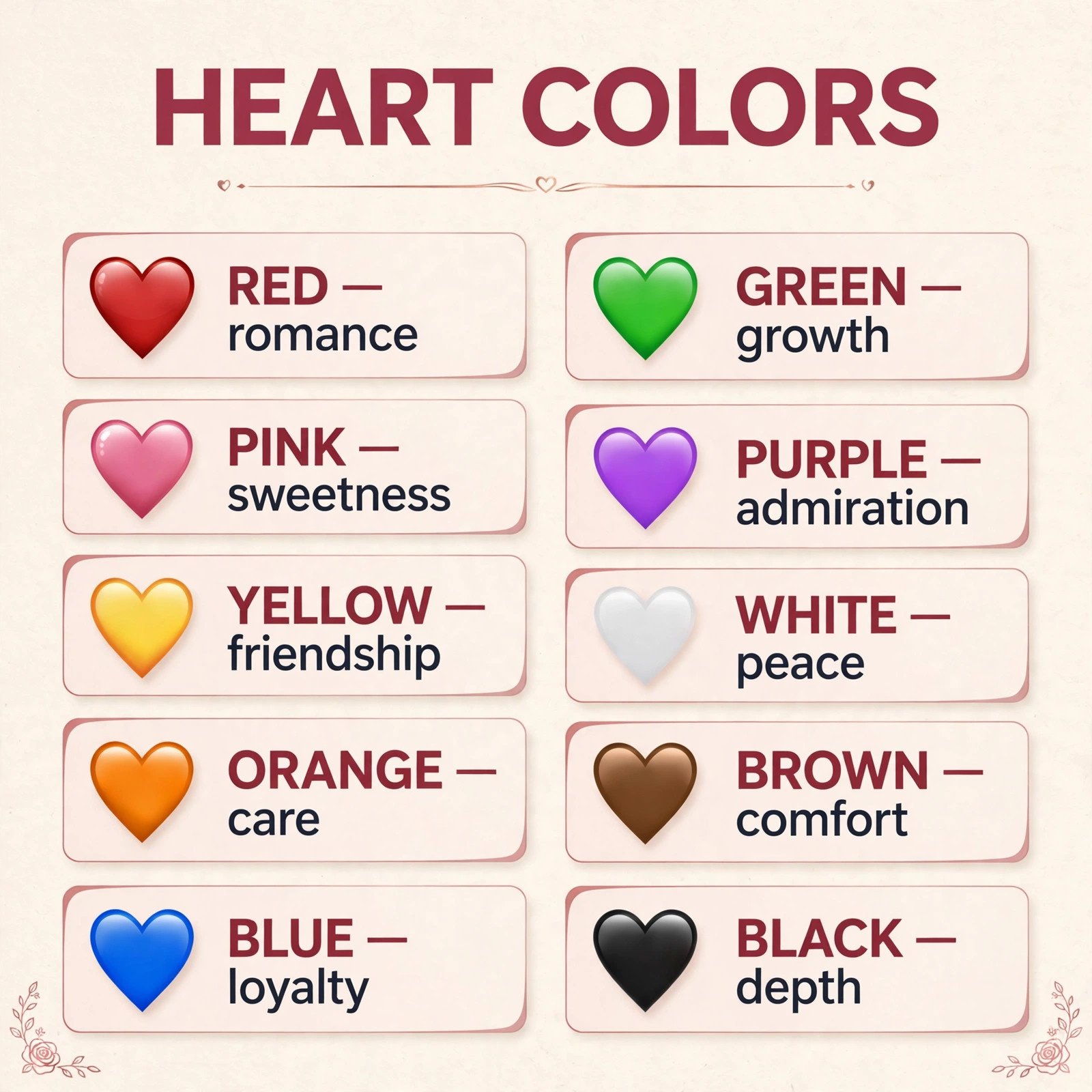
For feelings that run deeper or softer than everyday affection.
Purple: Admiration and Compassion
The purple heart 💜 means support, admiration, and compassionate affection. In particular, it’s the heart of “I see how hard you’re trying” — encouragement with elegance. For instance, BTS’s “I purple you” made it the ARMY fandom’s emblem of love between artists and fans.
Thus, purple works beautifully for admiration that isn’t romantic: mentors, creators you respect, friends going through something hard.
White: Purity and Peace
The white heart 🤍, on the other hand, means pure affection, peace, remembrance, and sympathy. Indeed, it’s the gentlest heart — used for condolences, for remembering someone lost, for new beginnings, and for love expressed with quiet sincerity. In serious messages, therefore, white asks to be read softly.
Brown: Comfort and Belonging
The brown heart 🤎 means comfort, stability, and grounded connection. Similarly, it’s warmth with roots — belonging, heritage, the feeling of home. It has also become an emblem of identity and solidarity, particularly in BIPOC communities. Thus, brown says “you’re safe here” in the most literal emotional sense.
Light Blue: Calm Affection
The light blue heart 🩵 (added in 2022), meanwhile, means calm affection, peace, and emotional softness. In short, it’s blue’s gentler sibling — tenderness without weight. Its meaning is still settling, but the direction is clear: quiet, easy warmth.
Grey: Neutral and Reserved
The grey heart 🩶 (also 2022) means neutral or reserved emotion — subtle support without intensity. It’s the shrug of hearts, in other words: “I acknowledge this” without committing to a feeling. Useful when you want to respond warmly but stay measured.
The Black Heart and Special Hearts
The hearts that need the most context — and reward it.
Black: Depth, Grief, or Edge
The black heart 🖤 is the most context-dependent heart of all. It can mean grief and mourning, dark humor and irony, gothic or edgy style, quiet solidarity — or simply understated affection from someone whose aesthetic runs dark. The same 🖤 can be devastating or playful depending entirely on the conversation around it.
Generally, in sad contexts, read it as grief; in funny contexts, read it as humor; in stylish contexts, read it as aesthetic. Finally, never use it in professional messages — the ambiguity isn’t worth it.
Broken, Beating, Growing, Sparkling
Beyond colors, hearts have states — and each adds meaning:
- Broken heart 💔 — heartbreak, sadness, disappointment. It’s the universal symbol of “this hurts.”
- Beating heart 💓 — excitement, nervous flutter, anticipation. It simply can’t sit still.
- Growing heart 💗 — affection that’s building, swelling with feeling.
- Sparkling heart 💖 — enthusiastic, celebratory love. Think of it as the “thank you, this is wonderful” heart.
- Mending heart ❤️🩹 — healing, recovery, getting better. Hope after heartbreak.
- Two hearts 💕 — mutual affection, “love is in the air.”
Heart Color Meanings: Quick Reference Chart
| Heart | Meaning | Best for |
|---|---|---|
| ❤️ Red | Romantic love, deep affection | Partners, closest loved ones |
| 🩷 Pink | Gentle, sweet, playful love | New crushes, tender moments |
| ❤️🔥 Heart on fire | Intense passion, desire | Burning romance |
| 💛 Yellow | Friendship, happiness, warmth | Friends, platonic love |
| 🧡 Orange | Friendly care, support | Comforting, thinking of you |
| 💙 Blue | Loyalty, trust, stability | Long-term bonds, teams |
| 💚 Green | Growth, health, harmony | Wellness, shared causes |
| 💜 Purple | Admiration, compassion | Mentors, encouragement |
| 🤍 White | Purity, peace, remembrance | Sympathy, new beginnings |
| 🤎 Brown | Comfort, belonging, roots | Home, identity, safety |
| 🩵 Light blue | Calm, soft affection | Gentle warmth |
| 🩶 Grey | Neutral, reserved | Measured responses |
| 🖤 Black | Grief, humor, edge | Context-dependent |
| 💔 Broken | Heartbreak, sadness | Loss, disappointment |
| 💓 Beating | Excitement, flutter | Anticipation |
| 💗 Growing | Building affection | Falling in love |
| 💖 Sparkling | Enthusiastic love | Celebration, thanks |
| ❤️🩹 Mending | Healing, recovery | Getting better |
How to Choose the Right Heart
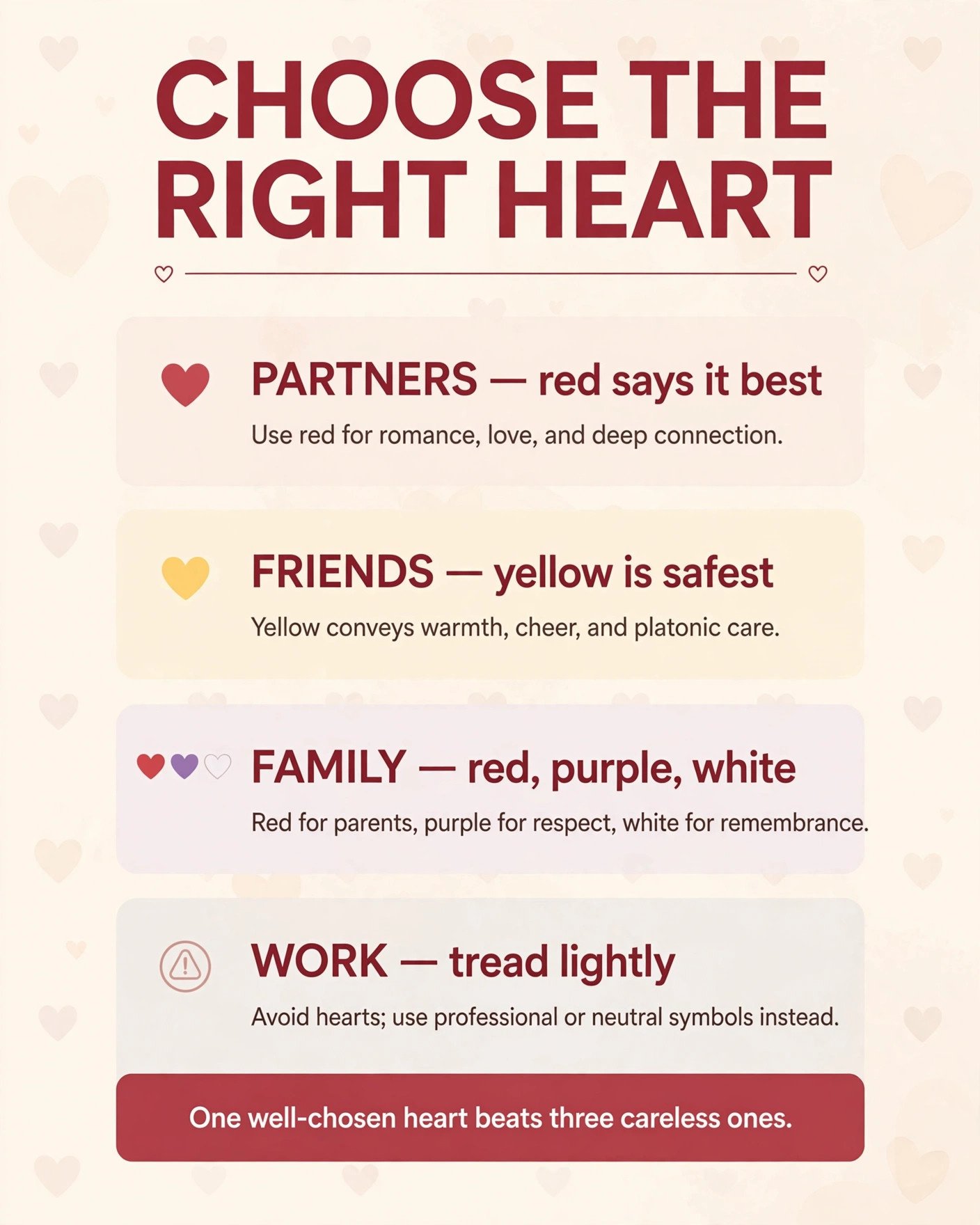
Here’s the practical framework — the part that stops the second-guessing.
Match the Heart to the Relationship
Romantic partners: ❤️ is the clearest choice. 🩷 softens it, ❤️🔥 intensifies it. Indeed, no other color says “I love you” as unambiguously.
Close friends: 💛 is the classic — warm without romantic confusion. 💙 adds loyalty, 🧡 adds care, 💚 adds shared-values warmth.
Family: ❤️ for the love that’s obvious, 💜 for admiration (a parent you’re proud of), 🤍 for gentle or difficult times.
Acquaintances and colleagues: tread lightly. 💙 or 💛 in warm professional contexts; otherwise, words alone are safer than any heart.
Difficult moments: 🤍 for sympathy, 💜 for support, 🖤 only if you know the person’s style welcomes it.
The Mistakes to Avoid
1. Don’t send ❤️ casually. After all, it’s the most romantic heart. If you wouldn’t say “I love you” to this person, don’t send the symbol that means it.
2. Don’t over-read received hearts. For instance, most people choose by habit or favorite color, not by this guide. One 💛 doesn’t define a relationship — patterns do.
3. Don’t use 🖤 professionally. Indeed, its ambiguity (grief? humor? edge?) makes it the riskiest heart at work.
4. Don’t stack hearts to intensify. ❤️❤️❤️ doesn’t mean triple love — it means emphasis, excitement, or just habit. In short, one well-chosen heart beats three careless ones.
5. When it matters, use words too. After all, a heart colors the tone; it can’t carry the message. “Thinking of you 💜,” for example, is clear. By contrast, “💜” alone is a guess.
In short: choose the heart that matches your intent, respect the red heart’s power, and remember that the best emoji is one the other person understands.
Heart Color Meanings: FAQs
What does 💛 mean from a guy? Usually friendship, warmth, or affection without romantic pressure. But context matters more than color — read the conversation, not just the heart.
Which heart emoji is the most romantic? ❤️, without question. It’s the universal symbol of romantic love. 🩷 is romantic but softer; ❤️🔥 is romantic but more about passion.
What does 🖤 mean? It depends on context: grief or mourning in sad messages, dark humor in funny ones, edgy style in aesthetic ones. It’s the most ambiguous heart — when unsure, ask or read the surrounding conversation.
What does 💜 mean? Support, admiration, and compassionate affection. It’s encouragement with elegance — popular, for instance, for fandoms (BTS ARMY), mentors, and friends going through hard times.
More Questions, Answered
What’s the difference between 💛 and 🧡? First, yellow is the established friendship heart — cheerful and platonic. Orange, by contrast, is warmer and more supportive — “thinking of you” rather than “you’re my bestie.” In short, both are safely non-romantic.
Can I use 💙 for a crush? You can, but know it reads as loyal and steady rather than passionate. If you want to signal romantic interest, 🩷 is clearer; 💙 keeps things warm but ambiguous.
What does 🤍 mean in a condolence message? Pure sympathy and remembrance — indeed, it’s one of the most appropriate hearts for grief, expressing gentle support without intruding.
Do heart colors mean the same on every platform? Mostly, yes — for instance, the conventions are cultural, not technical. But tone shifts by platform: a heart on private WhatsApp feels more personal than the same heart on public Instagram.
Conclusion
So what are the essential heart color meanings? Red for romance, yellow for friendship, blue for loyalty, purple for admiration, white for peace, black for depth — and a dozen more shades for everything in between. But the real lesson is the one this guide keeps returning to: hearts are cues, not contracts. In the end, they color your message; they don’t write it.
Therefore, choose with intent. Match the heart to the relationship, respect the red heart’s romantic weight, and when the feeling truly matters, let words do the heavy lifting with the heart as their accent.
If you enjoy decoding what colors, symbols, and words really mean, you’ll find more plain-English breakdowns like this one at Quote of Fame.