

Egyptian Symbols and Meanings Explained Simply

Walk into any museum’s Egypt wing and you will see them everywhere — a cross with a loop on top, a stylized watchful eye, a beetle with outstretched wings. This complete guide to ancient Egyptian symbols and meanings explains the most important of these signs in plain language, so you can finally understand what the ancient Egyptians were trying to say.
Most people recognize the Ankh or the Eye of Horus without knowing what either one actually stood for. That confusion is completely normal. Egyptian symbols were never decoration. Each one carried a specific job, whether it was protecting the dead, proving a king’s right to rule, or promising life after death.
So if you are wondering which Egyptian symbol means protection, which one means eternal life, or how to tell the Eye of Horus apart from the Eye of Ra, you are in exactly the right place. This guide walks you through the seven most powerful symbols first, then moves on to royal and funerary symbols, and finally shows you how people use them today — whether that means choosing a tattoo, reading a museum artifact, or simply satisfying your curiosity.
What Do Egyptian Symbols and Meanings Really Tell Us?
Before we look at individual symbols, it helps to understand what they were for. Ancient Egyptians did not carve these signs into temple walls to look pretty. Instead, they used them as a kind of visual shorthand for their deepest beliefs about life, death, power, and the gods. Because of that, every symbol answered a real question: how do we stay safe, how do we live forever, and who is in charge here?
It is also worth clearing up one common mix-up. Hieroglyphs and symbols are not quite the same thing. Hieroglyphs formed a full writing system with hundreds of signs for sounds, words, and ideas. Sacred symbols, on the other hand, made up a smaller set of religious emblems with fixed meanings. Some signs, like the Ankh, worked as both. If you enjoy decoding signs in general, our broader guide to symbols and meanings shows how other cultures built their own visual languages too.
Symbols turned up in three main places. First, on amulets — small charms worn by the living and buried with the dead for protection. Second, in tombs and on coffins, where they guarded the journey to the afterlife. Third, in temples and on royal objects, where they announced the pharaoh’s divine authority. Once you know this, a wall of carvings stops looking random and starts reading like a sentence.
The 7 Most Powerful Egyptian Symbols and Meanings, Explained Simply
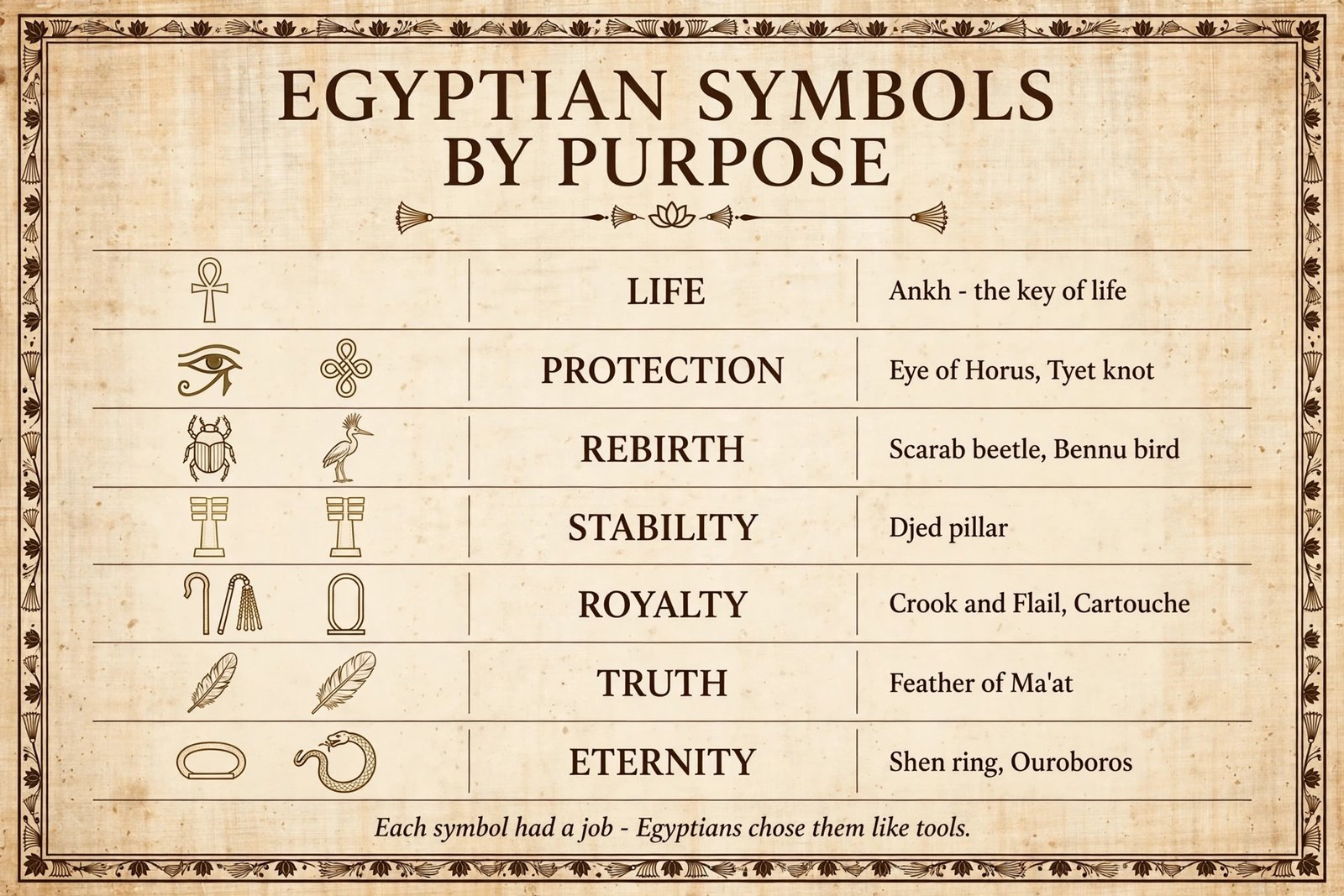
Thousands of symbols existed, but seven of them do most of the work. Learn these seven and you will recognize most of what you see in museums, books, and jewelry. Each one below includes what it looks like, what it meant, and where you are most likely to spot it.
The Ankh — Eternal Life
The Ankh looks like a cross with a loop at the top, and it is the most famous Egyptian symbol in the world. Its basic meaning is “life” — not just everyday life, but eternal life that continues after death. For that reason, people often call it the “key of life” or the “key of the Nile.”
In temple art, gods are constantly shown holding an Ankh to the pharaoh’s nose, as if letting him breathe in divine life. During purification rituals, streams of water poured over the king were drawn as chains of tiny Ankhs. The symbol also turned up on amulets placed with mummies, since the dead needed life just as much as the living.
Interestingly, the Ankh survived long after the pharaohs. Early Coptic Christians in Egypt adopted it as their own cross, and in the 1960s it became a wider emblem of African heritage and spiritual identity. You can read more about its long history in this detailed overview of the Ankh symbol.
The Eye of Horus — Protection and Healing
The Eye of Horus is a stylized human eye with bold cosmetic lines and a spiral curl beneath it. It stood for protection, good health, and restoration — and its meaning comes straight from a myth. According to the story, the god Horus lost his eye in a battle with Set, the god of chaos. The god Thoth then healed the eye and returned it to Horus, which is why the symbol also carries the name Wedjat, meaning “the sound one” or “the whole one.”
Because of that story, Egyptians wore the Eye of Horus as an amulet to ward off evil and speed healing. Sailors painted pairs of the eyes on the bows of their boats. Coffins often carried them too, so the dead could “see” their way through the afterlife.
Some writers have also linked parts of the eye’s design to the human senses — sight, hearing, smell, taste, and touch. That reading is an interpretation rather than a proven fact, but it shows how layered the symbol became over three thousand years of use.
The Eye of Ra — Solar Power and Royal Authority
The Eye of Ra looks similar to the Eye of Horus, which is exactly why people confuse the two. Here is the key difference: the Eye of Ra represents the sun, while the Eye of Horus represents the moon. Ra’s eye was the right eye; Horus’s was the left.
Where the Eye of Horus heals, the Eye of Ra defends. It embodied the fierce, burning power of the sun god as he destroyed his enemies and kept cosmic order. Fierce goddesses like Sekhmet and Hathor were sometimes described as the “Eye of Ra” when they acted as his agents of punishment.
On royal crowns and temple walls, the sun disk with its watchful eye announced that the king ruled with the sun god’s backing. It was protection with teeth — safety through overwhelming power rather than gentle healing.
The Scarab Beetle — Rebirth and Transformation
The scarab may seem like an odd choice for one of Egypt’s greatest symbols, yet it made perfect sense to the Egyptians. They watched dung beetles roll balls of dung across the ground, and that rolling reminded them of the sun being pushed across the sky each day. The beetle god Khepri, whose name means “he who comes into being,” was pictured as a scarab pushing the morning sun.
As a result, the scarab became the great symbol of rebirth, renewal, and transformation. Egyptians carved scarab amulets by the thousands. Special “heart scarabs” were placed over a mummy’s heart with a spell asking the heart not to betray its owner during judgment. Officials also used scarab-shaped seals to stamp documents, which is why so many survive in museums today.
If you ever feel stuck between an old chapter and a new one, the scarab’s message is simple: like the sun, you can rise again tomorrow.
The Djed Pillar — Stability and Strength
The Djed pillar looks like a column crossed by four horizontal bars near the top. It represented stability, endurance, and the backbone of the god Osiris. In Egyptian thought, a world without the Djed was a world that could collapse, so the symbol promised that order would hold.
Each year, priests performed a ceremony of “raising the Djed,” lifting a tall pillar upright while the king watched. The ritual acted out the triumph of order over chaos and linked the king’s reign to the resurrection of Osiris himself. Because of this, the Djed appears constantly in tomb paintings, usually at the back of the deceased where a spine would be — literally giving the dead person a strong backbone for the afterlife.
The Was Scepter — Divine Authority
The Was scepter was a long staff topped with a stylized animal head and ending in a forked base. Gods, pharaohs, and priests carried it as a badge of power and dominion. Where the Djed promised that the world would stand firm, the Was promised that someone capable was in charge of it.
In art, the Was often appears alongside the Ankh and the Djed as a trio: life, stability, and power. During purification scenes, gods pour water drawn as alternating Ankhs and Was symbols over the pharaoh — a visual way of saying the king received both life and authority from the gods. You will spot the Was in the hands of major gods like Ptah, Ra, and Set across temple reliefs.
The Feather of Ma’at — Truth and Justice
The Feather of Ma’at is a single tall ostrich feather, and it belonged to the goddess Ma’at, who embodied truth, justice, and cosmic order. Its most famous role came in the weighing of the heart ceremony, the moment every Egyptian hoped to pass after death.
In that judgment scene, the deceased’s heart was placed on a scale against the feather. If the heart balanced with the feather, the person had lived honestly and could enter the afterlife. If the heart weighed heavy with wrongdoing, it was devoured by a fearsome creature called Ammit. The feather therefore asked a direct question of every Egyptian: did you live in line with truth?
Royal Egyptian Symbols: Crowns, Cartouches, and Regalia
Beyond the great spiritual symbols, a second family of emblems belonged specifically to kingship. These royal symbols answered a political question: why should this particular person rule Egypt? Each one tied the pharaoh to the gods, to the land, or to both.
The Cartouche — A Ring Around the Royal Name
A cartouche is an oval ring with a small bar at one end, enclosing the written name of a pharaoh. The ring itself is a stretched-out Shen ring, and it meant that the king’s name — and therefore the king himself — was protected for eternity.
Cartouches also changed world history in a very practical way. When scholars were decoding hieroglyphs in the 1820s, they guessed that the ringed names on the Rosetta Stone belonged to kings. That guess gave Jean-Francois Champollion the foothold he needed to crack the whole writing system. So the cartouche did not just protect names; it eventually unlocked them.
The Crook and Flail — Leadership and Kingship
Pharaohs are almost always shown holding two objects crossed over their chest: a curved shepherd’s crook and a flail that looks like a short whip. The crook marked the king as the shepherd of his people, responsible for guiding and caring for them. Meanwhile, the flail marked him as the one who could punish, threshing out disorder the way grain is threshed.
Together, they expressed the two sides of kingship: care and control. No other Egyptian held them, which is why statues clutching the crook and flail are instantly recognizable as pharaohs.
The Uraeus — The Rearing Cobra
The Uraeus is the rearing cobra fixed to the front of the pharaoh’s crown. It represented the goddess Wadjet, protector of Lower Egypt, and it turned the king’s forehead into a weapon. According to belief, the cobra would spit fire at the king’s enemies.
The Uraeus therefore announced two things at once: the king enjoyed divine protection, and attacking him meant facing divine fire. It is one of the fastest ways to identify a pharaoh in art — if the cobra is on the brow, you are looking at royalty.
Deshret, Hedjet, and the Pschent — The Crowns of Two Lands
Egypt was famously “the Two Lands”: Lower Egypt in the north and Upper Egypt in the south. Each land had its own crown. The Deshret was the red crown of Lower Egypt, while the Hedjet was the tall white crown of Upper Egypt.
When a king wore both at once, the combination was called the Pschent, and it made a powerful claim: this ruler held Upper and Lower Egypt together as one. So the next time you see a double crown in a museum, you are looking at a statement about national unity, not just fancy headwear.
Egyptian Symbols of Death and the Afterlife
The Egyptians spent enormous energy preparing for what came after death, and their funerary symbols reflect that focus. These emblems were chosen for tombs, coffins, and mummies because each one solved a specific problem the dead were expected to face.
The Tyet — The Knot of Isis
The Tyet looks a little like an Ankh whose arms droop downward, and it is sometimes called the Knot of Isis or the Blood of Isis. It represented the protective, life-giving power of the goddess Isis, especially her magic as a mother and healer.
Tyet amulets were often made of red stone or red glass, since red suggested the blood of Isis and her fierce love for the dead. Mourners placed them on mummies to wrap the deceased in the goddess’s protection. Because it resembles the Ankh, beginners often mix the two up — the drooping arms are the giveaway.
The Shen Ring — A Circle With No End
The Shen ring is a simple circle of rope with a small straight bar at the bottom. Because a circle has no beginning and no end, it stood for eternity, infinity, and divine protection that never runs out.
Gods are frequently shown holding a Shen ring in each talon or resting them on the symbol, as if granting endless protection. The cartouche itself grew out of the Shen ring: someone simply stretched the circle into an oval so a royal name could fit inside. So every cartouche you see is really a Shen ring doing bodyguard duty around a name.
Ba and Ka — The Two Halves of the Soul
Egyptians believed a person was made of several spiritual parts, and two of them mattered most after death. The Ka was the life force, a kind of spiritual double that needed food, drink, and offerings to survive. That is why tombs were stocked with bread, beer, and everything else the Ka might want.
The Ba, on the other hand, was the personality — the part that made someone who they were. Artists drew it as a bird with a human head, free to fly out of the tomb by day and return to the body by night. For the afterlife to work, the Ba and Ka had to reunite with the preserved body each night. This belief is the real reason mummification existed: no body, no reunion.
The Ouroboros — The Serpent That Eats Its Tail
The Ouroboros shows a serpent curled in a circle, biting its own tail. It represented the eternal cycle of life, death, and rebirth — endings that feed directly into beginnings.
The image first appeared in Egyptian funerary texts, where it guarded the mysteries of the afterlife. Centuries later, Greek philosophers and medieval alchemists adopted it as their emblem of wholeness and the unity of all things. Few symbols have traveled further from their starting point while keeping their original meaning intact.
Eye of Horus vs Eye of Ra: How to Tell These Egyptian Symbols and Meanings Apart
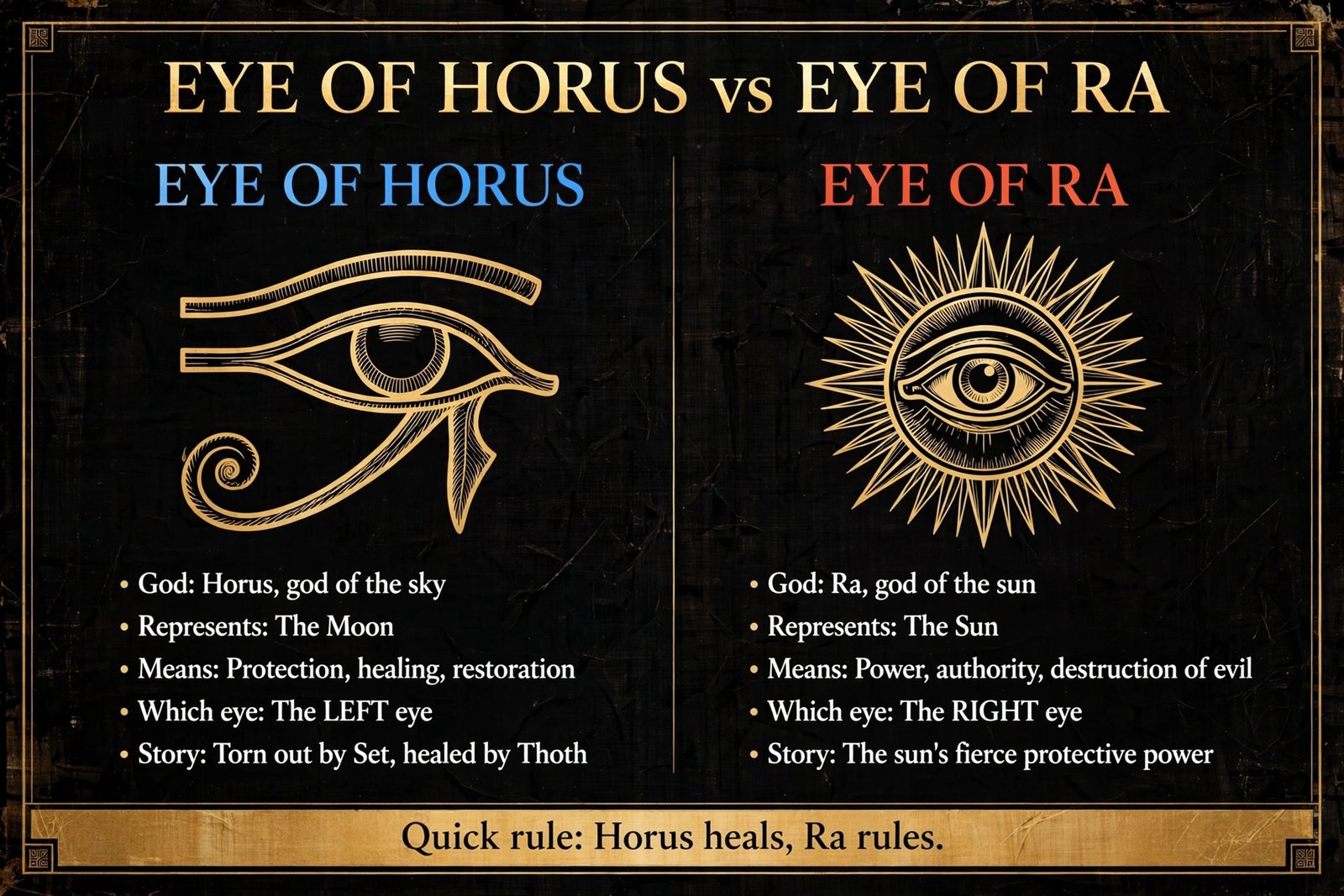
Of all Egyptian symbols and meanings, none cause more confusion than the two famous eyes. They look alike, they share the name “eye,” and plenty of websites mix them up. Here is a clear way to keep them straight.
The Two Eyes, Side by Side
Think of it this way: the Eye of Horus belongs to the moon, and the Eye of Ra belongs to the sun. Horus’s eye is the left eye; Ra’s is the right. Horus heals, while Ra rules.
The Eye of Horus came from a story of injury and recovery — Set tore it out, Thoth healed it — so it means protection, health, and restoration. The Eye of Ra came from the sun’s raw power, so it means authority, fiery defense, and the destruction of evil. One comforts you; the other warns your enemies.
Other Pairs People Mix Up
The two eyes are not the only lookalikes. The Ankh and the Tyet confuse beginners because both have a loop at the top — but the Ankh’s arms stick straight out while the Tyet’s arms droop down like a knot. One means life; the other means Isis’s protection.
The three crowns trip people up as well. Remember: Deshret is red and belongs to Lower Egypt in the north, Hedjet is white and belongs to Upper Egypt in the south, and the Pschent is both worn together as a claim over the unified country. Finally, the Was scepter and the Djed pillar sometimes blur together since both are tall and straight — but the Was has an animal head on top and a forked foot, while the Djed has four crossbars near its crown.
How People Use Egyptian Symbols and Meanings Today
Ancient Egyptian symbols did not stay in the past. Today they appear on necklaces, tattoos, home decor, book covers, and even company logos. That is completely natural — these are some of the most striking designs humans ever created.
If you are choosing a symbol for yourself, start with its meaning rather than its looks. An Ankh suits someone focused on new beginnings or remembrance. The Eye of Horus fits anyone wanting a protective emblem. A scarab works well for marking a personal transformation. Matching the symbol to your intention is exactly what the Egyptians themselves did.
One more piece of advice: verify the meaning before you ink it permanently. Because lookalikes like the two eyes and the Ankh-Tyet pair confuse even enthusiasts, double-check which one you actually want. A few minutes of checking now saves years of explaining later.
Where to See Real Egyptian Symbols in Person
Reading about symbols is one thing; standing in front of the real carvings is another. If you ever get the chance, the temples of Karnak and Luxor are covered in giant reliefs where you can spot the Ankh, Was, and Djed at full scale. Abu Simbel’s colossal statues wear the double crown, and the Valley of the Kings holds tombs painted with the weighing of the heart ceremony.
For museum visits, the Egyptian Museum in Cairo and the new Grand Egyptian Museum hold the greatest collections on earth. Outside Egypt, the British Museum in London, the Louvre in Paris, and the Metropolitan Museum of Art in New York all display world-class amulets, coffins, and jewelry. Bring this guide along, and those quiet glass cases will start talking.
FAQs
What is the ancient Egyptian symbol of love?
The Shen ring is the closest thing Egypt had to a love symbol. Because its unbroken circle meant eternity, couples exchanged Shen rings as tokens of endless devotion — an ancient ancestor of the wedding band. The Tyet knot also carried loving meaning, since it channeled the protective love of the goddess Isis.
What does the winged sun disk mean?
The winged sun disk shows the sun with outstretched wings, often with two cobras hanging beneath it. It represented Horus of Behdet in his role as divine protector, spreading his wings over temples and palaces. In short, it meant heavenly protection and the triumph of order over chaos, and it usually appeared above doorways and thrones.
Do colors change the meaning of an Egyptian symbol?
Yes, color added a whole second layer of meaning. Gold represented the flesh of the gods and immortality. Blue stood for the heavens and divine birth. Green meant vegetation, growth, and resurrection. Red signaled chaos, fire, and destruction. Black, surprisingly, was positive — it stood for the fertile Nile silt and therefore for fertility and rebirth. So a green scarab and a red scarab told slightly different stories.
Are hieroglyphs and Egyptian symbols the same thing?
Not exactly. Hieroglyphs were a complete writing system with hundreds of signs used to record language — sounds, words, and grammar. Sacred symbols were a smaller set of religious emblems with fixed spiritual meanings. The two systems overlapped: the Ankh, for example, worked both as the written word for “life” and as a holy emblem. Think of hieroglyphs as the alphabet and symbols as the icons.
Is it disrespectful to get an Egyptian symbol tattoo?
For most Egyptians today, respectful use is welcomed rather than resented. The key is understanding: choose a symbol whose meaning you genuinely connect with, get the design right (the two eyes are not interchangeable), and avoid mixing sacred emblems into jokes or disrespectful imagery. Treat the symbol the way its creators did — as something meaningful — and you will be on solid ground.
The Bottom Line
Egyptian symbols were never decoration. They were tools — for protection, for kingship, for truth, and for cheating death itself. Now that you know what the Ankh, the two eyes, the scarab, the Djed, and their companions actually meant, those museum walls and jewelry designs will never look mysterious again. They will look like messages. And now, you can read them.