

MYB Meaning: What It Means in Texting

If you just received a text containing “myb” and had no idea what the sender meant, you are not alone. Indeed, the myb meaning is one of the most searched texting questions online, because this tiny three-letter abbreviation can stand for three completely different things — and picking the wrong one can change the entire tone of a conversation.
In fact, depending on the context, MYB can mean “maybe,” “mind your business,” or “my bad.” One of those is harmless, one can sound rude, and one is an apology. Therefore, getting it right actually matters.
Are you staring at a message trying to work out which meaning fits? Are you wondering whether someone was being rude or just casual? Do you want to use MYB yourself without accidentally offending anyone? Thankfully, this guide walks through each meaning with real conversation examples, shows you how to decode the right one from context in seconds, and explains exactly when to use MYB — and when to leave it out of your messages entirely.
MYB Meaning in Texting: The Short Answer
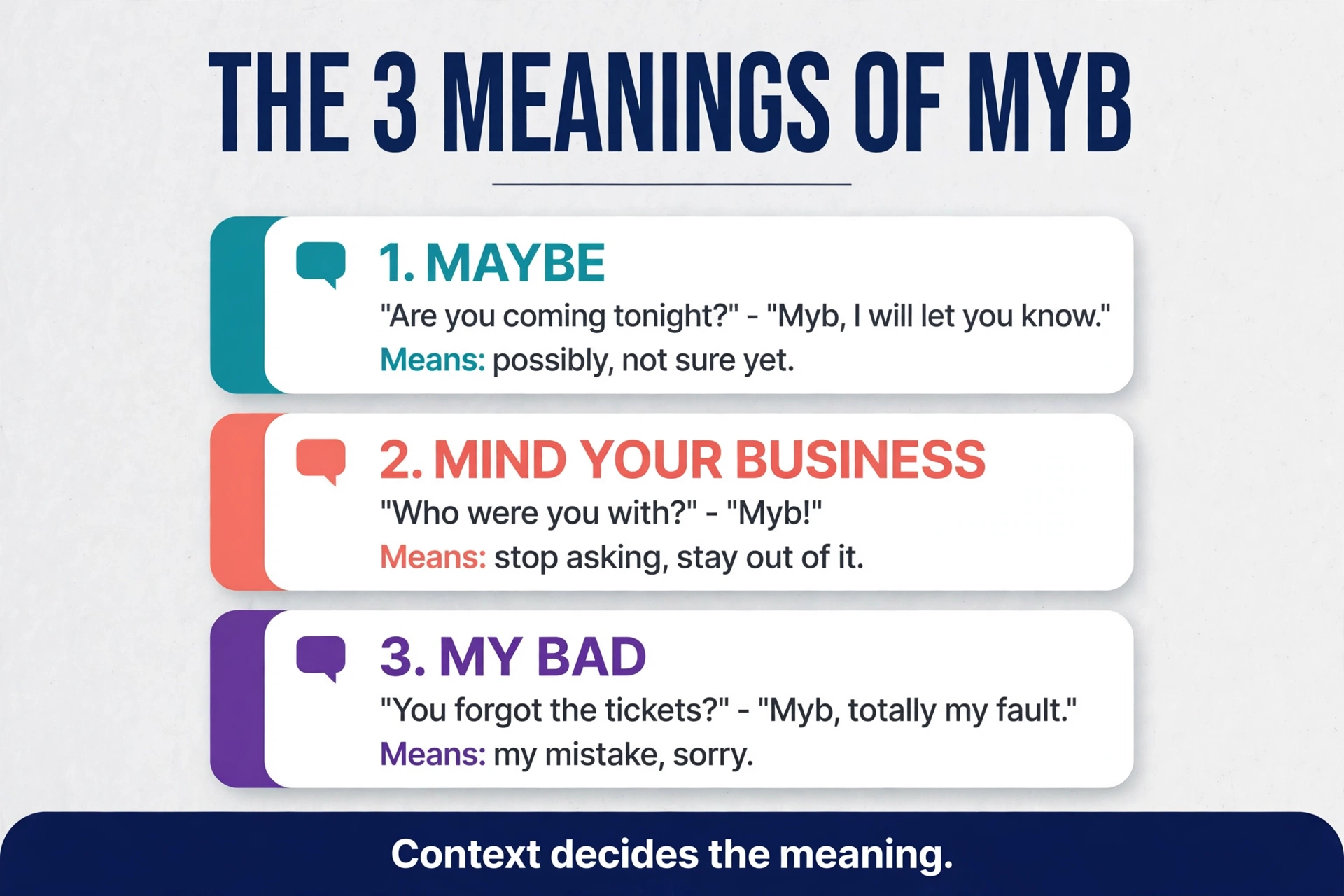
To begin with, MYB is a texting abbreviation with three common meanings: “maybe,” “mind your business,” and “my bad.” There is no single official definition, because slang grows organically — different groups of people adopted the same three letters for different phrases. As a result, the correct myb meaning always depends on the conversation around it.
Indeed, that ambiguity is exactly why so many people search for this term. By contrast, most abbreviations have one clear expansion, but MYB genuinely has three live contenders. Still, you can almost always figure out the right one. Fortunately, the question being answered, the tone of the chat, and your relationship with the sender are usually enough to decode it instantly — and later in this guide you will get a simple four-clue framework that makes it automatic.
For now, here is the honest summary: if someone is answering a plan or invitation, MYB almost always means “maybe.” If someone is shutting down a nosy question, it means “mind your business.” And if someone is owning up to a small mistake, it means “my bad.” The rest of this article shows you each meaning in action so you never have to guess again.
The 3 Main MYB Meanings
Below are the three meanings you will actually encounter, ordered by how often they show up in everyday texting. Moreover, each one comes with real examples so you can feel the difference in tone.
MYB Meaning #1: “Maybe”
First, the most common myb meaning in casual texting is “maybe.” It is simply a shortened way of expressing uncertainty — the texter is not saying yes or no, just leaving the door open. In particular, this usage is popular among younger texters on Snapchat, Instagram DMs, Discord, and WhatsApp, where speed matters more than formality.
You will usually see it as an answer to a question about plans, preferences, or decisions:
- “Are you coming to the party tonight?” — “Myb, I’ll let you know.”
- “Pizza or burgers?” — “Myb pizza, depends how hungry I am.”
- “Can you cover my shift Friday?” — “Myb, still checking my schedule.”
In each case, MYB does the same job as “maybe” — it buys time without committing. Overall, the tone is neutral and relaxed. However, be aware that in a serious conversation, replying with just “myb” can feel vague or non-committal, since it gives the other person nothing solid to work with. Still, among friends it is perfectly normal.
MYB Meaning #2: “Mind Your Business”
Second, “mind your business” — a short, pointed way of telling someone to stop prying. Unlike “maybe,” this one carries attitude. At times, it can be playful between close friends, but it can also sound sharp or defensive when the sender feels annoyed.
Here, context makes the difference obvious:
- Playful: “Who were you out with last night?” — “Haha, myb!”
- Defensive: “Why didn’t you reply for three hours?” — “Myb, I was busy.”
- Firm: “How much did that cost you?” — “Myb.”
Notice how the same three letters land completely differently depending on the question. In most cases, when MYB follows a personal or intrusive question, the “mind your business” reading is almost certainly the right one. After all, this meaning can sting, so it is worth thinking twice before sending it to anyone you are not close with — without facial expressions or tone of voice, even a joking “myb” can read as genuinely rude.
MYB Meaning #3: “My Bad”
Third, “my bad” — a casual way of admitting a small mistake. In other words, this is the apology version of MYB: quick, informal, and best suited to minor slip-ups rather than serious offenses. Notably, Dictionary.com lists “my bad” as an idiom meaning “my fault; my mistake” (see their entry for “bad,” which includes the idiom), which confirms this reading has real linguistic roots going back to 1980s American slang.
Typical uses look like this:
- “You sent the file to the wrong group!” — “Myb, resending now.”
- “Did you forget we had plans today?” — “Myb! Totally slipped my mind.”
- “That was my slice of pizza.” — “Myb, I’ll order another.”
This version of MYB works like a verbal shrug — it owns the error without making a big production of it. Still, keep it proportional: “my bad” is fine for a forgotten text or a minor mix-up, but it can sound dismissive if the mistake actually hurt someone. On the other hand, for anything serious, a real apology beats an abbreviation every time.
How to Tell Which MYB Meaning Someone Intends
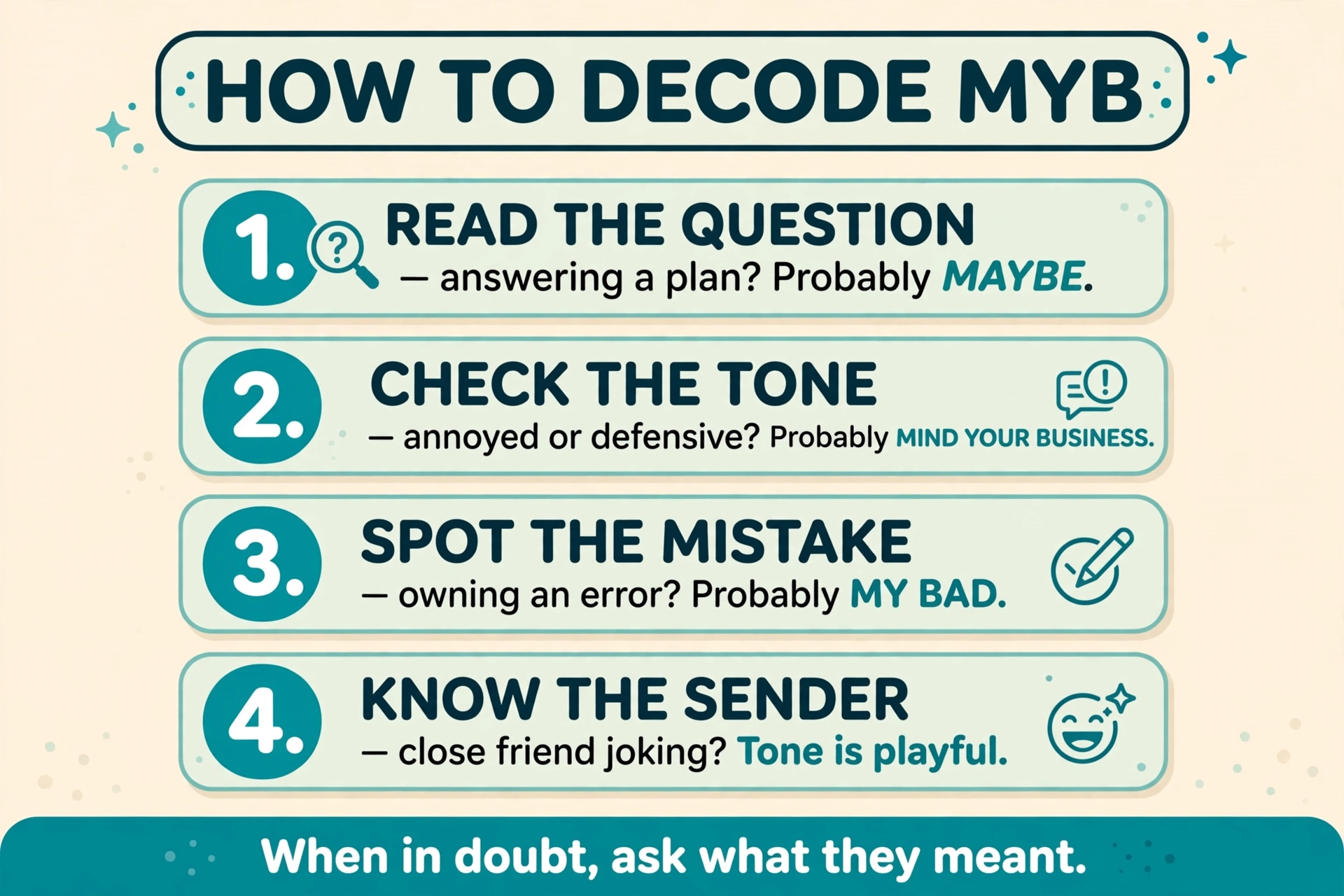
Now for the practical part: decoding MYB in about five seconds. Instead of memorizing definitions, run the message through these four context clues. In fact, in almost every real conversation, one of them gives the answer away immediately.
First, Clue 1: read the question it answers. If MYB is a reply to an invitation, a plan, or a choice (“Are you free?”, “Should we go?”), it means “maybe.” This is the most common pattern by far, so start here.
Next, Clue 2: check the emotional temperature. If the conversation feels tense, or MYB follows a personal question the sender clearly did not want to answer, it means “mind your business.” A defensive or annoyed tone is the giveaway.
Then, Clue 3: look for a mistake being owned. If something just went wrong — a forgotten task, a wrong message, a missed plan — and MYB arrives right after, it means “my bad.” The apology context is unmistakable.
Finally, Clue 4: consider who sent it. Close friends tease each other, so a playful “myb” from a best friend after a nosy question is usually a joke. By contrast, the same message from an acquaintance, a coworker, or someone you barely know deserves a more careful reading.
In the end, when two clues point the same way, you can be confident. Even so, when you genuinely cannot tell — which happens — there is no shame in asking. A quick “Haha, what do you mean by myb?” clears it up in seconds, and most people would rather explain than be misunderstood.
MYB in Real Conversations: Examples That Show the Difference
Definitions only go so far — the fastest way to internalize MYB is to see it inside realistic exchanges. For instance, below are three short dialogues, one per meaning, with notes on what signals each reading.
Example 1 — “Maybe”
Sara: “Movie night Friday? I’m thinking the new comedy.”
Dan: “Myb, depends when I get off work.”
Sara: “No worries, just let me know by Thursday.”
Why this is “maybe”: Dan is answering a plan, not shutting anyone down or apologizing. In addition, his follow-up (“depends when I get off work”) confirms the uncertainty reading. Thus, this is the everyday, default use of MYB.
Example 2 — “Mind Your Business”
Sara: “You were online at 3am. Who were you talking to?”
Dan: “Myb, haha”
Sara: “Okay okay, just curious!”
Why this is “mind your business”: the question is personal, and Dan deflects it instead of answering. Still, Dan’s “haha” and Sara’s relaxed reply show this particular exchange is playful teasing between friends — the same words without the emoji, or from a stranger, could easily feel hostile.
Example 3 — “My Bad”
Sara: “You were supposed to bring the snacks!”
Dan: “Myb, I completely forgot. I’ll grab some on the way.”
Sara: “You’re forgiven. Get the good chips.”
Indeed, why this is “my bad”: a small mistake just happened, Dan owns it immediately, and he follows up with a fix. As a result, that apology-plus-action pattern is the signature of the “my bad” meaning. In contrast, notice how different it feels from the first two — same letters, completely different job.
On the whole, if you compare the three, the pattern becomes clear: the meaning of MYB is never really in the letters themselves. Instead, it lives in the sentence before it.
Is MYB Rude? What the Tone Really Depends On
Naturally, this is one of the most common follow-up questions, and the honest answer is: it depends entirely on which meaning is in play. “Maybe” is never rude — it is just casual. Similarly, “My bad” is the opposite of rude; it is a small apology. However, only “mind your business” has any real potential to offend, because it is literally an instruction to back off.
Even so, context decides everything. For example, between close friends, “myb” after a nosy question is usually banter — the friendship itself acts as a cushion. On the contrary, between acquaintances, coworkers, or family members you are not close with, the cushion disappears, and the same message can land as genuinely dismissive.
Accordingly, there are two practical rules worth remembering. First of all, never send the “mind your business” version of MYB to someone who cannot see your face — in plain text, sarcasm and annoyance look identical. Second, if you receive a “myb” that stings, pause before reacting. After all, the sender may have meant the harmless “maybe” while you read the sharp “mind your business.” Misreading tone in text messages is one of the most common causes of unnecessary arguments, and a three-letter abbreviation is exactly the kind of message that gets misread.
When to Use MYB — and When to Avoid It
Typically, MYB belongs in casual, low-stakes messaging: texts with friends, group chats, Discord servers, gaming lobbies, and social media comments. Consequently, in those settings, it does its job well — keeping things fast, light, and informal.
Nevertheless, there are places where it does not belong:
- Work emails and professional chats. Even the harmless “maybe” reading looks sloppy in a professional setting. Instead, write the full word.
- Job applications and formal writing. Abbreviations signal casualness, which is the opposite of what formal writing needs.
- Serious or emotional conversations. If someone is upset with you, answering with “myb” can look like you are not taking them seriously — especially if they read it as “mind your business.”
- Messages to older relatives or anyone unfamiliar with texting slang. If the reader has to google your reply, the abbreviation has failed at its one job: quick communication.
As a rule, use MYB only where you would also feel comfortable using “lol” or “tbh.” If the setting calls for complete sentences, spell things out.
MYB vs Similar Slang: MB, MYOB, IDK, and TBH
Still, MYB is often confused with a few neighboring abbreviations, so here is how they differ:
- MB (“my bad”) overlaps with only one MYB meaning — the apology. Unlike MYB, MB never means “maybe” or “mind your business,” so it causes fewer misunderstandings when you specifically mean “my mistake.”
- MYOB (“mind your own business”) is the unambiguous version of MYB’s sharpest meaning. Accordingly, use MYOB when you want zero doubt about your intent.
- IDK (“I don’t know”) expresses lack of knowledge, not uncertainty about plans. In other words, “myb” keeps options open while “idk” admits you have no answer.
- TBH (“to be honest”) adds candor to a statement. By contrast, it frames what follows, whereas MYB replaces a whole reply.
Above all, the most useful distinction is MYB vs MB. Indeed, they look almost identical and share the “my bad” meaning, but MB is the safer, more established apology abbreviation, while MYB carries the extra ambiguity of its other two readings. Therefore, when you specifically mean “my mistake,” MB actually causes fewer misunderstandings.
Finally, for more texting slang explained in plain language, you can browse the full collection at quoteoffame.com — including guides to abbreviations like WBU, NVM, FR, and HY that show up in the same chats where MYB appears.
MYB Meaning on Snapchat and Social Media
Naturally, you might wonder whether MYB means something different on Snapchat, Instagram, or TikTok. Not really — indeed, the three meanings travel unchanged across platforms. However, each platform nudges one meaning to the front.
For instance, on Snapchat, where conversations are fast and streaks keep people replying quickly, the “maybe” version dominates. In other words, snaps and chats move too fast for boundary-setting; most MYBs you see there are non-committal replies to plans. Meanwhile, on Instagram and TikTok comments, the “mind your business” reading shows up more often, usually as a playful or sassy reply to a nosy comment — frequently softened with a laughing emoji. Similarly, in gaming chats on Discord, all three appear: “maybe” for strategy calls, “my bad” after a misplay, and “mind your business” as banter between teammates.
Thus, the platform itself becomes a fifth context clue. For example, a “myb” on Snapchat is very likely “maybe”; the same letters under a TikTok comment are more likely “mind your business.” It is not a rule, but it tilts the odds.
FAQs
How do you pronounce MYB?
Say it letter by letter: “em-why-bee.” In fact, some people pronounce the “my bad” version as “my bee,” but spelling it out works everywhere and nobody will misunderstand you.
What should I reply when someone texts me “MYB”?
First, match the meaning. When it meant “maybe,” reply as you would to “maybe” (“No rush, let me know”). Meanwhile, if it meant “my bad,” a quick “all good” closes the loop. Finally, if it meant “mind your business,” take the hint gracefully — pushing back usually just extends an awkward exchange.
Is MYB passive-aggressive?
That said, it can be, but it usually is not intended that way. Still, the “mind your business” reading is the only one with real passive-aggressive potential, and even that is often just playful. Therefore, if you are on the receiving end and unsure, assume the kinder reading first.
Does MYB mean something different on dating apps?
Admittedly, some people rarely use MYB to mean “miss you baby” in romantic chats — but this is uncommon and heavily dependent on the relationship. As a result, in dating-app conversations with someone new, assume one of the three main meanings instead.
Can I use MYB at work?
Not safely. After all, even in a casual workplace chat, the abbreviation risks being read as “mind your business” by a colleague who does not know the slang. Instead, type the full word you mean.
Conclusion
Ultimately, the myb meaning is not one thing — it is three: “maybe,” “mind your business,” and “my bad.” That is the entire source of the confusion, and also the entire solution. To sum up, once you know the three candidates, the context almost always hands you the answer: a plan being discussed means “maybe,” a nosy question being deflected means “mind your business,” and a small mistake being owned means “my bad.”
The deeper lesson is one that applies to all texting slang. In general, abbreviations save keystrokes but cost clarity, and the shorter the abbreviation, the more work the context has to do. Ultimately, the next time “myb” lands in your messages, read the sentence before it — that is where the real meaning has been hiding all along.