


Flag Color Meanings: Complete Guide

If you have ever looked at a national flag and wondered what the flag color meanings really mean, you are asking one of the most popular questions in vexillology, the study of flags. The short answer is encouraging: flag colors are almost never random. They are chosen to say something about a country’s history, values, faith, or landscape.
The longer answer is where it gets interesting. The same color can mean very different things on different flags. Red might stand for the blood of revolutionaries on one flag and for prosperity on another. This guide will give you the widely accepted meanings for every major flag color, show you real flags that use them, and explain how to read the colors of any flag you come across. You will also learn why some colors, like purple, barely appear on flags at all.
Do any of these questions sound familiar? Are you trying to decode the colors of a specific country’s flag for a school project? Are you designing a flag and want colors that send the right message? Or are you simply curious why so many flags look like variations of red, white, and blue? This guide walks you through each color step by step so you leave with a clear, reliable answer instead of a vague guess.
Flag Color Meanings at a Glance
Before the detailed breakdowns, here is the quick-reference version of the most widely accepted flag color meanings. Vexillologists and flag makers generally agree on these associations, although individual countries sometimes assign their own specific meanings.
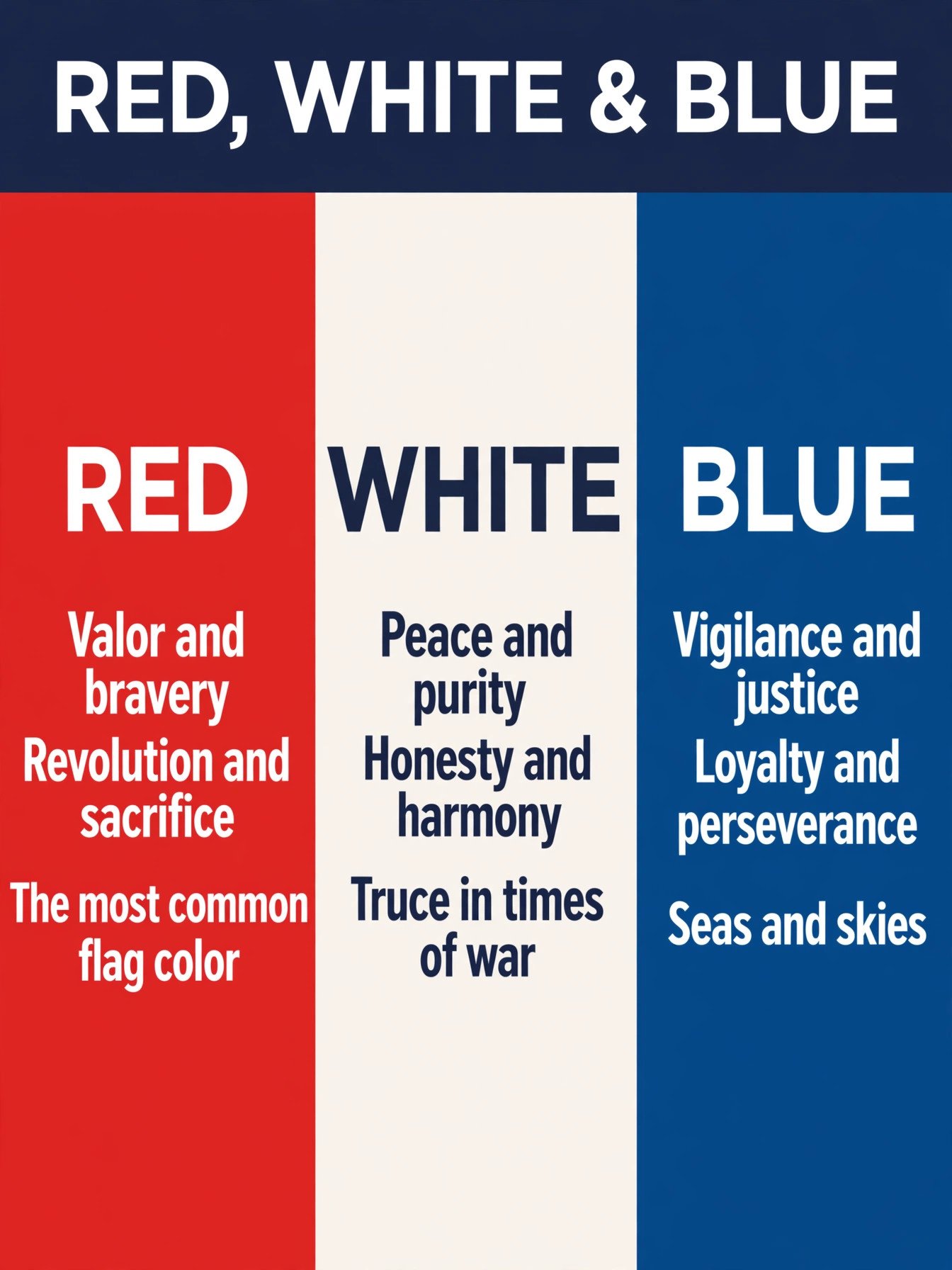
- Red: courage, bravery, sacrifice, revolution, and strength. It is the most common color on national flags.
- White: peace, purity, honesty, and unity. It is also the international signal of truce.
- Blue: loyalty, vigilance, perseverance, and justice. It often represents seas and skies.
- Green: land, agriculture, fertility, hope, and renewal. It is strongly associated with Islam.
- Yellow/Gold: wealth, prosperity, sunlight, energy, and generosity.
- Black: determination, ethnic heritage, strength, and mourning.
- Orange: sacrifice and courage.
- Purple: royalty, wealth, and luxury. It is the rarest color on national flags.
Keep this chart handy, but remember the most important rule of flag color meanings: context decides. A color’s meaning on a particular flag comes from that flag’s own history and official explanation, not from a universal dictionary.
Do Flag Color Meanings Change From Country to Country?
Yes, and this is the single biggest misunderstanding about flag color meanings. Many people assume each color has one fixed meaning, the way a traffic light does. Flags do not work that way. An infographic study by the Copenhagen agency Ferdio, covered by Fast Company, analyzed the stated symbolism of national flags and found that while patterns exist, the same color can carry different official meanings in different countries. Red’s most common meaning across flags is blood or sacrifice, yet on some flags red officially stands for prosperity or the sun.
There are several reasons for this. First, many flag colors come from a country’s own story rather than from a global code. The green on Saudi Arabia’s flag represents Islam, while the green on Brazil’s flag represents its forests. Second, regional history matters. The red-yellow-green tricolor appears across many African flags because those Pan-African colors carry a shared meaning of liberation, while the same colors elsewhere might mean something entirely different. Third, some meanings shift over time. A color adopted to honor a revolution can later be explained as standing for a national virtue.
So how should you use the meanings in this guide? Treat them as the most common, widely accepted associations. Then, when you want the meaning of a specific flag, look for that country’s official explanation. That two-step approach gives you both the general pattern and the correct specific answer.
Red on Flags: Blood, Courage, and Revolution
Red is the most common color on national flags. One widely cited count puts red on roughly 78 percent of them, ahead of blue at about 71 percent. The dominant meanings are courage, bravery, sacrifice, and revolution. On many flags, red officially represents the bloodshed in the struggle for independence or freedom.
The colors of the American flag carry one of the best-documented examples. According to USA.gov, red stands for valor and bravery. The same three meanings were chosen in 1782 for the Great Seal of the United States: white for purity and innocence, red for hardiness and valor, and blue for vigilance, perseverance, and justice. Historians note that the practical story matters too. As the North American Vexillological Association’s Ted Kaye has explained, red, white, and blue were partly chosen because white could be produced by bleaching fabric while red and blue dyes were durable, unlike black, which faded quickly.
You will also find red carrying revolutionary energy on flags such as China’s, Vietnam’s, and the former Soviet Union’s, where it signaled revolution and the people’s struggle. On Spain’s flag, by contrast, red sits alongside gold in a design tied to historic kingdoms rather than revolution. The lesson is consistent: red almost always signals strength and sacrifice, but the exact story belongs to the country.
White on Flags: Peace, Purity, and Honesty
White is the international symbol of peace. Even in the middle of a war, a white flag signals a truce or surrender, and that meaning carries into national flag design. On country flags, white most commonly stands for peace, purity, honesty, and unity.
The Ferdio analysis found that white’s meanings cluster around virtues: peace first, then purity, honesty, and harmony. On the American flag, white officially means purity and innocence. Pakistan gives white a specific job: its white stripe represents the rights and freedom of religious minorities, standing beside the green field that represents the Muslim majority. On Japan’s flag, the white background creates a field of simplicity and honesty around the red sun disc.
Because white pairs well with strong colors, it appears on a huge share of flags as a balancing element. In practice, when you see white on a flag, peace and purity are the safest interpretation, although it is always worth checking whether the country has assigned it a more specific meaning.
Blue on Flags: Loyalty, Justice, and Vigilance
Blue is the second most common flag color, appearing on about 71 percent of national flags. Its core meanings are loyalty, vigilance, perseverance, and justice. Beyond those virtues, blue frequently represents the sea, the sky, and freedom.
The range of blue’s meanings is wider than most colors. On the American flag, blue means vigilance, perseverance, and justice. On many island and coastal nations, blue stands for the surrounding ocean. Lighter shades often point specifically to the sky or water; a detailed flag color guide notes that light blue represents the sky, water, seas, and rivers. On the flag of the United Nations, light blue was chosen to suggest peace and neutrality.
When you compare blue across flags, you will notice it rarely carries aggressive meanings. While red signals struggle and sacrifice, blue signals stability, trust, and calm authority. That contrast is one reason the red-white-blue combination dominates world flags: the colors balance each other emotionally as well as visually.
Green on Flags: Land, Faith, and Hope
Green is the color of nature, and on flags it most often represents the land itself: forests, fields, agriculture, and fertility. The Ferdio analysis found green’s meanings stick closely to nature across flags, with landscape as the most common and natural resources close behind.
Green also carries one of the strongest religious associations of any flag color. On the flags of Saudi Arabia, Pakistan, and many other Muslim-majority countries, green represents Islam. During the American Revolution, green appeared on the Pine Tree flag, and today it represents hope and renewal on numerous African and Middle Eastern flags. On Brazil’s flag, the large green field represents the country’s vast forests, while on Ireland’s flag, green stands for the country’s Catholic heritage and its famously green landscape.
Because green’s two big meanings, nature and faith, are both positive and aspirational, it is a popular choice for young nations and movements that want to project growth and renewal. If you see green dominating a flag, the land or the faith of the people is usually the explanation.
Yellow and Gold on Flags: Wealth, Sunlight, and Energy
Yellow and gold are the colors of the sun, and that is exactly what they most often represent on flags: sunlight, energy, and optimism. Their second major meaning is wealth, especially where gold was historically mined. One analysis of flag symbolism notes that yellow can mean mineral wealth for one nation and generosity for another, which shows how much local context matters.
On Germany’s flag, the gold band historically represented wealth, power, and prestige. Spain uses yellow differently: its broad yellow stripe sits between two red bands in a design rooted in the country’s historic kingdoms. On many African flags, yellow or gold represents the continent’s mineral riches and the bright sun overhead. On Malaysia’s flag, the yellow crescent and star reflect the country’s royal heritage.
Designers should note that yellow is a high-visibility color. On flags it draws the eye immediately, which is why it works well for central emblems like suns, stars, and crescents. If you are reading a flag and yellow dominates, think sun, wealth, or royal heritage first, then check the country’s own story.
Black on Flags: Determination, Heritage, and Mourning
Black is one of the most misunderstood flag colors because it carries both proud and somber meanings. On national flags, black most commonly represents determination, the ethnic heritage of a people, or strength. It can also signify mourning or death, and in protest contexts it signals defiance.
On Germany’s flag, the black band was said to symbolize the dignity and determination of the German people. On many African flags, black represents the people themselves and their heritage, often paired with red for the struggle and green for the land. The black in the Pan-African color scheme is a deliberate statement of identity and pride.
The somber side of black appears in mourning flags and in the pirate flags of history, where it signaled defiance and danger. Because black dye faded quickly in earlier centuries, it was also a less practical choice for national flags, which partly explains why it appears less often than red, white, or blue. When you see black on a flag, determination and heritage are the most likely meanings, with mourning as the context-dependent alternative.
Orange on Flags: Sacrifice and Courage
Orange is a less common flag color, used on fewer than 10 percent of national flags, but its meaning is fairly consistent: sacrifice and courage. It sits emotionally between red’s aggression and yellow’s optimism, which gives it a distinctive energy.
The best-known orange flag element is the saffron band at the top of India’s flag, where it officially stands for courage and sacrifice. Orange also appears on the flags of Ireland, Ivory Coast, and Niger, where it often represents the land, particularly savannas and deserts, alongside its meaning of sacrifice. On the flag of Bhutan, orange represents Buddhist spiritual tradition.
Because orange is rare on national flags, it makes a flag instantly recognizable. If you are designing a flag and want it to stand out while still signaling courage, orange is one of the most distinctive choices available.
Purple on Flags: Royalty and the Rarest Flag Color
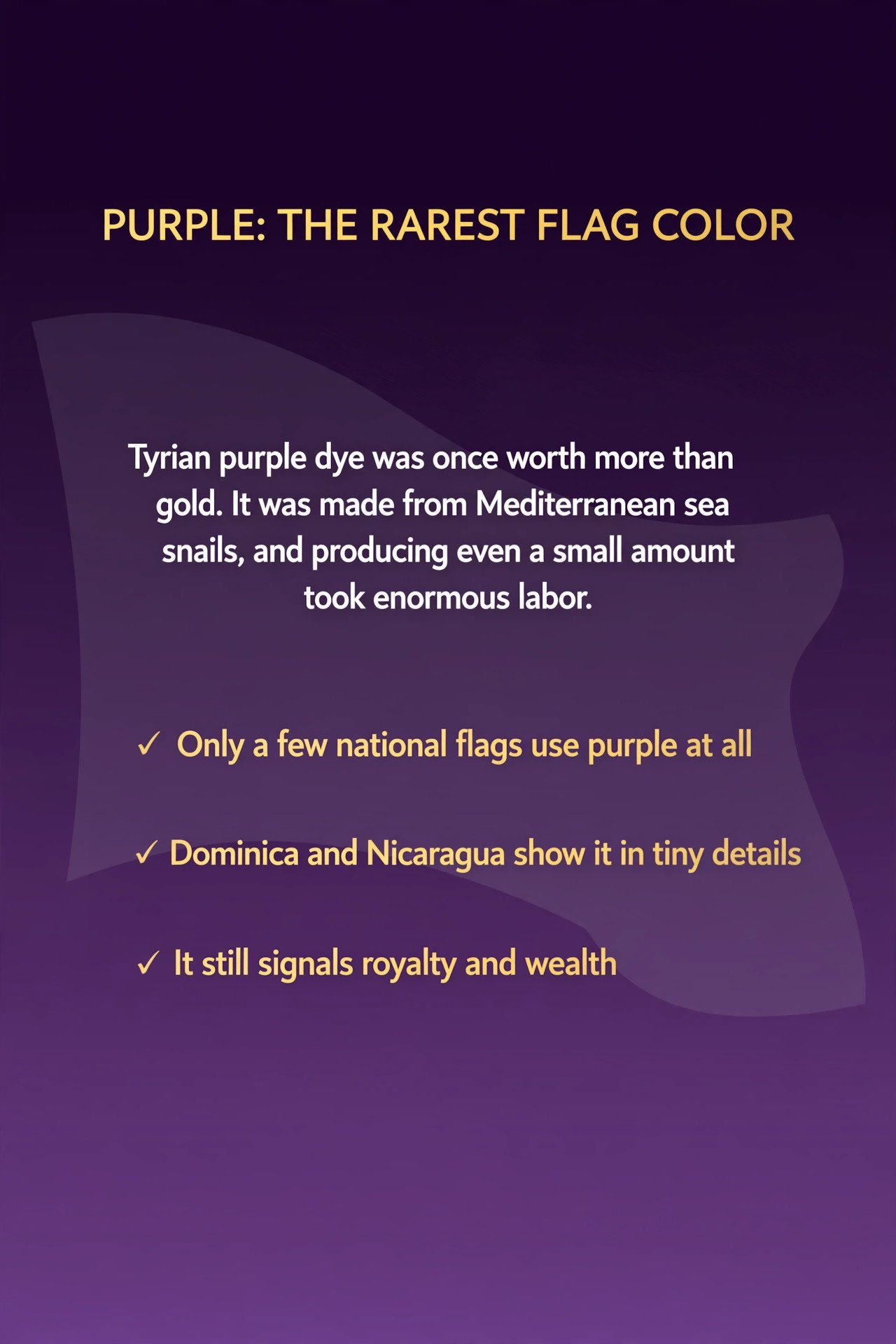
As flag maker Elmer’s Flag explains, purple is the least-used color on flags around the globe, and the reason is practical, not symbolic. For most of history, purple dye was extraordinarily expensive. It was made from a particular type of Mediterranean sea snail, and by some accounts it took around 120 pounds of snails to produce a single gram of dye powder. Purple became the color of emperors and nobility precisely because almost nobody else could afford it.
As a result, virtually no national flag adopted purple when flags were being designed in the 18th and 19th centuries. Today, only a few national flags include purple at all, most often cited are Nicaragua and Dominica, and even there it appears only in tiny details of the central emblem. Sources differ slightly on the exact count, since some count small purple elements on other flags, but every source agrees it is by far the least used flag color. Spain’s Second Republic used purple in its tricolor from 1931 to 1939, which remains one of the rare historical examples of a prominent purple flag.
The symbolism of purple itself is consistently royal: wealth, luxury, dignity, and sovereignty. Its absence from flags is a reminder that flag colors were shaped as much by economics and technology as by meaning. Now that synthetic dyes are cheap, purple appears more often on organizational, regional, and pride flags, but national flags have mostly kept their historic designs.
How to Read Flag Color Meanings Step by Step
If you want to decode the colors of a specific flag rather than learn general meanings, follow this practical method. It works for school projects, trivia, and design research.
First, identify the exact flag. Similar designs can belong to different countries, so confirm the country or organization before researching the colors. A quick image search usually settles this.
Second, look for the country’s official explanation. Many governments publish the symbolism of their flag on official sites. For the United States, for example, USA.gov states the color meanings directly. Official sources beat third-party summaries every time.
Third, consider the region and history. Pan-African colors, Pan-Arab colors, Pan-Slavic colors, and Nordic crosses all carry shared regional meanings. If a flag uses one of these established palettes, the regional story often explains the colors better than the general color guide.
Fourth, read the symbols along with the colors. Stars, suns, crescents, crosses, and animals usually have their own documented meanings, and they often clarify what the colors are meant to say. On Pakistan’s flag, for instance, the white stripe’s meaning of minority rights only makes full sense alongside the green field’s meaning.
Finally, remember that some color choices were practical. Durable dyes, visibility at sea, and the influence of earlier flags all shaped national designs. When a color’s official meaning seems thin, history usually fills the gap. For more color symbolism guides, you can explore the meaning articles on Quote of Fame.
FAQs
Why are so many national flags red, white, and blue?
There are two overlapping reasons. The practical one is that white could be produced by bleaching cloth while red and blue dyes were cheap and durable, unlike black, which faded fast, so early flag makers gravitated toward them. The historical one is influence: Britain’s Union Jack spread red, white, and blue across its empire, and the French tricolor and American Stars and Stripes made the combination a symbol of republican ideals. Once the trio became associated with liberty and modern nationhood, new nations kept adopting it.
What do the colors of the Olympic rings mean?
Each of the five rings represents a continent: blue for Europe, yellow for Asia, black for Africa, green for Oceania, and red for the Americas. The colors themselves were chosen for a clever reason. When Pierre de Coubertin designed the flag, unveiled at the 1920 Antwerp Olympics, he selected colors so that at least one of them appears on the flag of every nation on Earth. The rings therefore symbolize global unity and the universality of the Games.
What do the colors of the rainbow pride flag mean?
The rainbow flag was created by artist Gilbert Baker for San Francisco’s 1978 Gay Freedom Day Parade. In the original eight-color design, each stripe had a meaning: hot pink for sexuality, red for life, orange for healing, yellow for sunlight, green for nature, turquoise for art and magic, indigo for serenity and harmony, and violet for spirit. The hot pink stripe was later dropped because the dye was hard to source, and turquoise was removed to give an even number of stripes, leaving the familiar six-color version.
What do the colors of Tibetan prayer flags mean?
Tibetan prayer flags use five colors representing the five elements: blue for the sky or space, white for air or clouds, red for fire, green for water, and yellow for earth. The flags carry prayers and mantras that believers say are spread by the wind, bringing compassion, peace, strength, and wisdom to the surrounding area.
Was there ever a plain single-color national flag?
Yes. From 1977 to 2011, Libya’s national flag was a plain green field with no emblem, symbol, or additional color, making it the only single-color national flag in modern history. It was replaced after the fall of the Gaddafi government. No current national flag is a single solid color.
Do lighter and darker shades of the same color change the meaning?
They can. Light blue on a flag often points specifically to the sky, water, or the sea, as on the United Nations flag, while dark blue leans toward authority, vigilance, and justice. Similarly, bright saffron orange can signal courage where a deeper gold suggests wealth and royalty. Shade is a secondary signal rather than a separate meaning, so treat it as a refinement of the color’s main symbolism.
The Bottom Line on Flag Color Meanings
Flag color meanings are a language, but it is a language with local dialects. Red, white, and blue dominate the world’s flags because they combine powerful symbolism with a practical history of durable dyes. Green speaks of land and faith, yellow of sun and wealth, black of determination and heritage, and orange of sacrifice. Purple’s near-total absence tells its own story about the economics of dye.
The next time you see a flag you do not recognize, you now have a reliable starting point. Match the colors to their most common meanings, then check the country’s official explanation to confirm. That habit will give you the right answer far more often than guessing from the colors alone.