

JS Meaning in Text and How People Use It in Chats
A close friend ends a message with two small letters, “js,” and suddenly the whole sentence feels harder to read. Fortunately, the js meaning in text is simpler than it first appears. In everyday chatting, js stands for “just saying,” and people attach it to the end of an opinion, a reminder, or an awkward truth so the words land more gently.
Of course, the message may have felt friendly, or it may have felt like a quiet jab. Still, you are in the right place, because tone is exactly where most readers get stuck. After all, the same two letters can soften a compliment, carry honest advice, or hide a small dose of sarcasm.
So, are you wondering what the sender really meant? Are you unsure whether to laugh, agree, or feel offended? Or do you simply want to use the term correctly yourself? Accordingly, this guide resolves each of those questions in order. First, it gives the quick meaning. Next, it explains the tone shades. Finally, it shows real-style chat examples, platform differences, and the replies that work best.
JS Meaning in Text at a Glance
In short, js almost always means “just saying” when it appears at the end of a chat message. Admittedly, two smaller uses exist as well, and the table below separates them clearly. As a result, position becomes your fastest clue: read where the letters sit, and the meaning usually reveals itself.
| What you see | It means | Used for | Typical tone |
|---|---|---|---|
| js at the end of a message | just saying | Softening an opinion, advice, or warning | Casual, gentle, sometimes pointed |
| js in the middle of a sentence | just | Typing the word “just” at full speed | Neutral and hurried |
| JS in a tech or work chat | JavaScript | Discussing code, websites, or files | Professional and technical |
Clearly, the first row covers the overwhelming majority of everyday messages. For instance, when a friend writes “that sequel dragged a bit js,” nobody is discussing programming. Instead, the sender is offering an opinion while quietly adding, “please do not take this the wrong way.” Basically, js works like a small verbal shrug that travels with the sentence. That is also why the js meaning in texting is the version nearly every reader is looking for.
What Does JS Mean in Text? The Simple Definition
Put simply, js is the shortened form of the spoken phrase “just saying,” which itself comes from “I’m just saying.” Traditionally, speakers used that phrase right after a blunt remark to soften its impact. Similarly, texters now achieve the same effect with two letters, because chatting rewards speed above almost everything else.
Importantly, js does not change what the sentence says. Rather, it changes how the sentence asks to be received. In practice, without the tag, “your phone battery will not last the trip” sounds like a scolding. With the tag added, the same words become a helpful heads-up between friends. Therefore, think of js as packaging rather than content: the message stays honest, while the wrapping stays friendly.
Moreover, the term belongs firmly to informal spaces. Specifically, friends, siblings, classmates, and close coworkers use it constantly in quick chats. Conversely, formal emails, school assignments, and messages to senior managers deserve the full words, or no disclaimer at all. Indeed, the popular slang reference SlangDex describes the term in its js entry as current, casual shorthand that stays out of professional writing.
Where the Phrase Comes From
Surprisingly, the spoken phrase is far older than the smartphone. Indeed, defensive uses of “I’m just saying” appear in novels from the 1930s, long before texting existed. Later, comedians in the 1990s turned “just sayin'” into a catchphrase, and audiences carried it into everyday speech.
Afterward, early chatrooms and SMS messages created pressure to shorten everything, because character limits punished long phrases. Consequently, “just saying” shrank to js during the same wave that produced brb, idk, and omw. Eventually, Dictionary.com added js to its acronym guide in 2018, which confirmed that the abbreviation had fully entered mainstream use.
The Four Tone Shades Behind JS
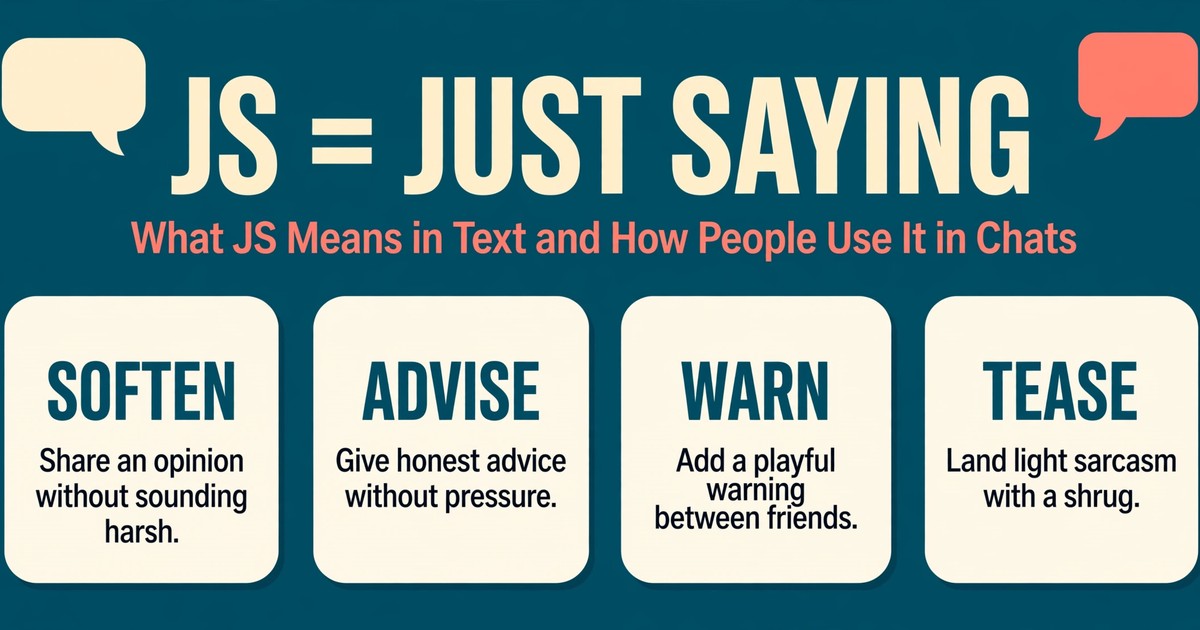
Admittedly, one definition cannot capture every message, because the sentence before js decides how the tag feels. Generally, though, nearly every use falls into one of four shades. After that, the sender’s intention becomes much easier to judge.
Softening an Opinion
Most commonly, js wraps a personal opinion in softer packaging. For example, “the new cafe is lovely, but the music is too loud js” shares a complaint without sounding like an attack on anyone’s taste. In this way, the sender separates the opinion from any argument about it. Ultimately, the message says: here is my view, and you remain free to disagree.
A Playful Warning
Sometimes, js carries a warning that the sender wants you to hear without panic. Typically, the warning concerns something small and slightly funny, like spicy food, a dying battery, or a nap that will definitely not stay short. Because the stakes stay low, the tone stays teasing rather than serious. Still, the advice inside the joke is usually genuine.
Honest Advice Without Pressure
In other cases, js delivers sincere guidance while removing any sense of command. For instance, “start the application tonight js” urges action, yet it leaves the final decision entirely with you. Interestingly, this shade appears often between close friends, precisely because they trust each other. Hence, the tag quietly means: I care enough to mention it, and I respect you enough not to push.
Light Sarcasm and the Raised Eyebrow
Occasionally, however, js sharpens a message instead of softening it. After a pointed remark, the tag reads like a raised eyebrow: “you left the group chat on read for three days js.” In such moments, the sender absolutely means the criticism, and js merely provides polite cover. Therefore, always judge this shade by the relationship and the sentence itself, never by the two letters alone.
How People Use JS at the End of a Message
Predictably, the end of the message is where js does its main work. In effect, it comments on everything written before it, almost like a footnote about tone. Furthermore, end-position js lets the sender add the disclaimer after seeing how the sentence looks, which mirrors how people speak.
Beyond that, the tag often arrives as its own tiny follow-up message. Often, a friend sends the opinion first, pauses, and then adds “js” alone in the next bubble. In effect, the pause recreates the spoken shrug even better than the attached version. Either way, the function stays identical: opinion delivered, offence disclaimed.
JS at the Start of a Message
Less frequently, js opens a message instead, as in “js, the tickets are cheaper on weekdays.” Here, the disclaimer arrives first, warning the reader that an opinion is coming. Admittedly, this order feels slightly more deliberate, because the sender planned the softening in advance. Nevertheless, the meaning remains “just saying,” and only the rhythm changes.
JS in the Middle of a Sentence Means “Just”
Meanwhile, a completely different use hides in the middle of sentences. In fast lowercase typing, js often replaces the plain word “just,” as in “i js got home” or “js ignore him.” Naturally, “just saying” would make no sense in those positions, so context exposes the shortcut instantly. When the letters sit inside a sentence rather than after it, read them as “just” and move on.
JS vs Just Saying vs TBH, NGL and FYI
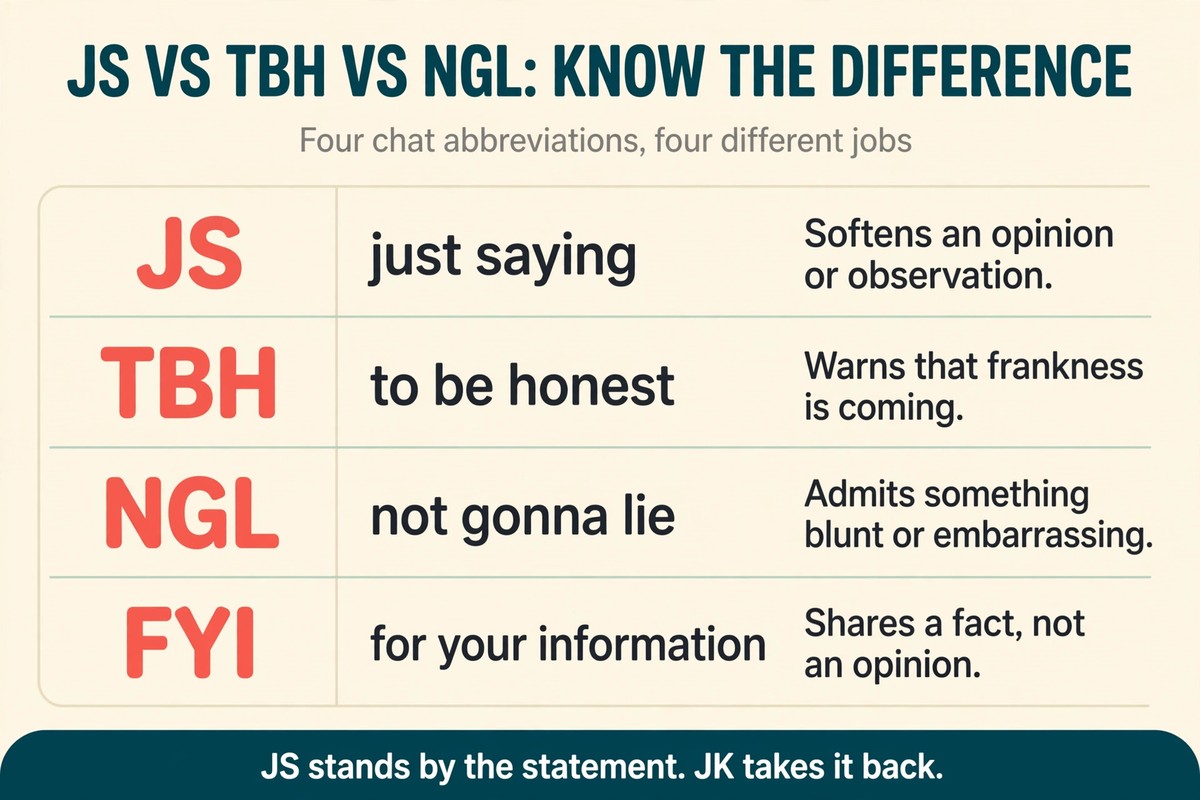
Because texting abbreviations overlap heavily, readers often confuse js with its neighbours. Fortunately, each abbreviation does a distinct job, and the differences are easy to learn. In particular, js and its full form soften opinions, while tbh and ngl announce honesty, and fyi delivers plain information.
| Term | Full form | What it actually does | Quick example |
|---|---|---|---|
| js | just saying | Softens an opinion or observation | “That sequel dragged a bit js” |
| just saying | just saying | Same job, slightly warmer and clearer | “Just saying, the first one was better” |
| tbh | to be honest | Warns that frankness is coming | “tbh, I never liked that cafe” |
| ngl | not gonna lie | Admits something blunt or embarrassing | “ngl, I forgot the meeting entirely” |
| fyi | for your information | Shares a fact rather than an opinion | “fyi, the class moved to room 12” |
| jk | just kidding | Takes the previous statement back | “You are fired. jk, obviously” |
Notice, above all, the contrast between js and jk. Whereas jk cancels a statement, js stands behind it. “You are wrong, jk” retreats completely, while “you are wrong, js” keeps the claim and only softens its delivery. Similarly, tbh and ngl promise honesty about facts or feelings, whereas js promises harmlessness about opinions. Finally, fyi stays neutral: it points at information, not at anyone’s judgement.
JS Meaning in Text on Snapchat, Instagram, WhatsApp and TikTok
Interestingly, the core meaning never changes between apps, yet each platform bends the tone slightly. Therefore, the js meaning in text stays “just saying” everywhere, while the surrounding culture decides whether it feels playful, public, or pointed. Next, each major platform gets a short reading of its own habits.
Snapchat
Typically, js thrives in fast, disappearing chats between close friends on Snapchat. Typically, it appears in replies to snaps and in short text overlays on photos. Because Snapchat conversations feel private and playful, the tag usually reads as teasing rather than rude. Moreover, senders often pair it with a selfie reaction, which makes the shrug almost visible.
Meanwhile, js shows up in direct messages, story replies, comments, and captions on Instagram. Notably, public comments change the stakes, since a pointed js under someone’s post is visible to everyone. Consequently, friendly uses dominate captions, where creators add js to opinions about outfits, trips, and food. In DMs, by contrast, it behaves exactly like ordinary texting.
Similarly, js circulates mainly in friend groups and family chats on WhatsApp. However, mixed-age groups create the biggest misunderstanding risk, because older relatives may never have seen the abbreviation. For that reason, a js that feels gentle to you might simply confuse your grandfather. When the chat includes several generations, spelling out “just saying” prevents needless puzzlement.
TikTok
Finally, js lives in TikTok comment sections, where opinions about videos fly quickly. Frequently, commenters attach it to judgements about dances, recipes, outfits, or life advice in the video. Since comments are public and brief, the sarcasm shade appears here more often than anywhere else. Still, context and the replies beneath usually reveal whether the commenter was joking or jabbing.
JS Meaning in Text Examples: 28 Chats That Show Every Tone
Above all, examples teach faster than definitions, so the js meaning in text becomes clearest inside real-style conversations. Accordingly, the twenty-eight short chats below are grouped by tone, from gentle opinions to light sarcasm. After each exchange, a brief note names the shade, so you can train your eye as you read.
Softening an Opinion
Maya: Did you enjoy the new cafe on Fifth Street?
Leo: The coffee was great, but the music was far too loud js.
In this chat, js wraps a complaint about volume, not about Maya’s choice of cafe.
Maya: How was the sequel?
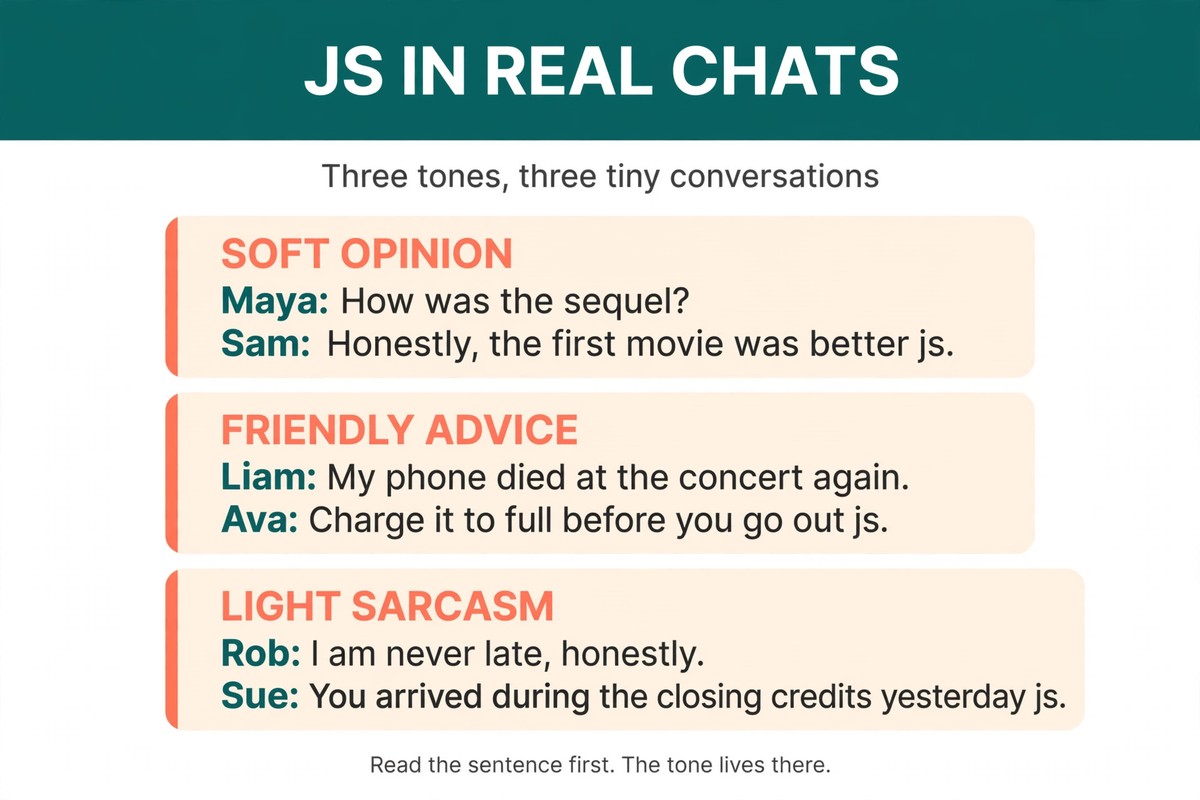
Sam: Honestly, the first movie was better js.
In this exchange, the tag keeps a film opinion from sounding like an argument.
Alex: What did you think of my presentation?
Jordan: It was solid overall. The middle slides felt a little rushed js.
Similarly, the criticism stays specific and gentle, thanks to the disclaimer at the end.
Nina: Should I post this photo from the trip?
Tom: It is a good one. The filter makes it look darker than real life js.
Meanwhile, Tom praises the photo first, so the js note lands as help, not doubt.
Sara: Is this dress too bright for the office party?
Ben: It is bold, for sure. You pull it off though js.
By contrast, Ben uses js to make an honest answer feel encouraging.
Chris: Did the team like the new schedule?
Dana: Mostly, yes. Fridays still feel packed js.
Finally, this js softens a mild complaint about one crowded day.
Honest Advice and Friendly Reminders
Emma: I keep forgetting my umbrella everywhere.
Noah: Check the forecast before you leave the house js.
In this exchange, the advice is practical, and the tag keeps it from sounding like an order.
Liam: My phone died at the concert again.
Ava: Charge it to full before you go out js.
In this case, Ava offers a reminder drawn from Liam’s own repeated experience.
Zoe: I am nervous about tomorrow’s interview.
Max: You will do fine. Just reach ten minutes early js.
Likewise, Max pairs encouragement with one calm, useful instruction.
Ruby: I have three assignments due on Friday.
Jack: Start with the hardest one tonight js.
Notably, the js here turns study strategy into a friendly nudge.
Lily: Should I text him again right now?
Owen: Give it a day first js. Double texts rarely help.
Instead of commanding her, Owen shares a gentle warning about timing.
Mia: I skipped breakfast again today.
Eli: Your body runs on food, not vibes js.
Ultimately, Eli’s humour carries sincere advice about eating properly.
Playful Warnings
Sam: I am thinking of trying the extra-spicy wings.
Kim: Your funeral. Order a glass of milk with them js.
As a result, the warning sounds theatrical, yet the milk advice is completely real.
Dan: One more episode, then I will definitely sleep.
Amy: That is what you said three episodes ago js.
In this exchange, Amy predicts Dan’s future using his own history.
Leo: I am going to assemble this shelf without the manual.
May: Bold choice. Keep the bandages nearby js.
Meanwhile, May teases the plan while quietly expecting minor chaos.
Tom: I bet I can finish this whole pizza alone.
Zoe: Famous last words js.
By contrast, Zoe needs only three words, because the js carries the whole joke.
Ben: I will just nap for ten minutes, promise.
Ana: Set two alarms js. Ten-minute naps are lies.
Finally, Ana’s warning protects Ben from his own optimism.
Light Sarcasm and Honest Call-Outs
Kim: Why is everyone annoyed with me today?
Raj: You did leave the group chat on read for three days js.
In this chat, js provides polite cover for a criticism Raj fully means.
Dan: Traffic was not my fault this time, honestly.
Amy: Sure, and the lights turned red just for fun js.
In this reply, the sarcasm does the talking, and js adds the raised eyebrow.
Jay: I carried the whole team that round.
Mel: You also died first, twice js.
Similarly, Mel deflates a boast with a fact nobody can dispute.
Pat: My cooking is basically restaurant level now.
Lou: The smoke alarm agrees with you js.
Instead of arguing, Lou lets one household witness deliver the verdict.
Rob: I am never late, you know that.
Sue: You arrived during the closing credits yesterday js.
Ultimately, Sue’s example is so specific that js barely needs to soften it.
Compliments and Positive Notes
Ann: Do these earrings suit me at all?
Kay: They were made for you js.
In this case, js makes a strong compliment sound relaxed instead of rehearsed.
Tim: I finally passed my driving test today.
Uma: Knew you would. You drive better than half the instructors js.
In this exchange, playful exaggeration carries genuine pride.
Fay: I redecorated my whole room this weekend.
Gil: It looks like a magazine cover now js.
Likewise, Gil’s js keeps praise casual between close friends.
Ian: Here is the song I recorded last night.
Joy: Genuinely, that chorus could live on the radio js.
Notably, the word “genuinely” proves js can underline sincerity, not just jokes.
Hal: I made soup completely from scratch today.
Ida: See? You are a better cook than you admit js.
Instead of a plain compliment, Ida turns the moment into encouragement.
Ned: I got the promotion this morning.
Pam: Deserved, completely. Hard work looks good on you js.
Finally, Pam’s js frames celebration as a shared, easy joy.
How to Reply When Someone Adds JS to a Message
Fortunately, replying well is easier than decoding, because the sender has already signalled a relaxed tone. Generally, your reply should match the shade you identified: warm for advice, playful for warnings, and calm for sarcasm. Notably, the three situations below cover nearly every js message you will ever receive.
If You Agree With the Point
When the comment is fair, a short acknowledgement works beautifully. For example, replies like “fair point,” “true, noted,” or “yeah, you are right” close the topic without fuss. Also, you can thank the sender, since honest advice usually comes from care. Either way, agreement needs no long defence, because js was never an accusation.
If the Comment Stings a Little
Sometimes, however, a js message lands harder than the sender intended. In that case, a light question clears the air faster than silent offence. For instance, “wait, was that a joke or real advice?” invites honesty without starting a fight. Similarly, “noted — tell me more” works when you suspect a serious point hides under the casual tag.
If You Genuinely Disagree
When you disagree, respond to the opinion itself rather than to the two letters. Instead, you might write “I see it differently, but go on” or “interesting, my experience was the opposite.” Because js softened the delivery, a measured reply keeps the exchange friendly. Above all, avoid mocking the abbreviation, since that escalates a small moment into a real argument.
When JS Means JavaScript Instead
Of course, one major exception exists, and it lives in the tech world. In programming conversations, JS is the universal short name for JavaScript, the language that powers interactive websites. Typically, developers write about “vanilla JS,” share files ending in .js, and advertise jobs asking for JS experience.
Fortunately, context separates the two meanings almost every time. When the chat concerns code, websites, or a developer’s job, JS means JavaScript. Conversely, if the chat concerns feelings, plans, or opinions, js means “just saying.” Additionally, capitalization offers a hint: tech writers usually type JS in capitals, while texters keep the slang lowercase. In short, topic first, position second, and the js meaning in text never stays ambiguous for long. When decoding chat slang becomes a habit you enjoy, the guides and quote collections on Quote Of Fame cover plenty of neighbouring terms as well.
Common Mistakes and Misunderstandings
Even so, confident texters misread js occasionally, usually by treating the tag as stronger or weaker than it is. Fortunately, the common errors repeat themselves, so they are easy to avoid once named. In fact, the four mistakes below account for nearly every awkward js moment.
Reading JS as JK
Firstly, many readers confuse js with jk, and the error flips the entire message. Whereas jk cancels a statement as a joke, js confirms the statement while softening it. Consequently, treating a sincere “js” message as a joke can make you laugh at something the sender genuinely meant. When the two look similar, remember: kidding retreats, saying stays.
Assuming JS Is Always Rude
Secondly, some readers assume every js hides an insult. In reality, most uses are friendly, and many carry compliments or useful advice. Granted, the sarcasm shade exists, but it remains the minority. Therefore, read the full sentence and consider the sender before assigning any offence. More often than not, the shrug is sincere.
Using JS in Formal Messages
Thirdly, js becomes a mistake when it enters formal writing. In an email to a manager, a teacher, or a client, the abbreviation looks careless and may not even be understood. Instead, write “just saying” in full, or remove the disclaimer entirely and let the sentence stand professionally. After all, casual slang belongs in casual spaces, and js is no exception.
Adding JS to Every Message
Finally, overuse quietly drains the tag of its value. When every opinion ends with js, the disclaimer stops sounding relaxed and starts sounding insecure. Moreover, constant softening can make honest feedback harder to trust. So, save js for moments that genuinely need a cushion, and let ordinary statements travel without one.
Frequently Asked Questions
Does js mean something different from a guy than from a girl?
Put simply, no: the meaning stays identical regardless of who sends it. Occasionally, readers imagine a gender difference because tone feels personal, yet the tag itself carries no such signal. Instead, the sentence, the relationship, and the conversation history decide whether js feels sweet, neutral, or sharp. In practice, a close friend’s js and a stranger’s js differ far more than a guy’s and a girl’s ever could.
Can js be a complete reply on its own?
Occasionally, yes. A sender may post an opinion, think about how it sounded, and then send “js” alone as the next message. In that position, the lone tag works like a delayed shrug attached to the previous bubble. Consequently, read a standalone js as a comment on the sender’s own last message, not as a reply to yours.
What does JSP mean in texting?
JSP is a rarer variant that stands for “just saying please.” Essentially, it adds an explicit layer of politeness on top of the usual softening. For example, “I do not think his intentions are good, jsp” delivers a warning with extra courtesy. Because the variant is uncommon, though, most readers will simply read it as js with a typing quirk.
What does #js mean on social media posts?
As a hashtag, #js performs the same job in public. Typically, creators attach it to opinion posts, hot takes, and light complaints so followers read the post as casual rather than confrontational. Interestingly, dictionary coverage of the abbreviation has cited #js posts as evidence of mainstream use. So, whether it ends a DM or tags a post, the letters keep one meaning: just saying.
Is js outdated, or do people still use it?
In fact, people still use js constantly across texting and social platforms. Admittedly, slang cycles quickly, yet this abbreviation has survived since the instant-messaging era because it solves a permanent problem: opinions need cushions. Notably, current slang references continue to list it as active, everyday shorthand. Therefore, using js today sounds normal, not dated, as long as the setting stays informal.
Conclusion
In short, the js meaning in text comes down to two small words with one clear job. Whether it softens advice, delivers a playful warning, or adds a raised eyebrow, js always points back to “just saying.” Meanwhile, position tells you when it simply means “just,” and topic tells you when it means JavaScript instead.
Next time those two letters end a message, you can read the tone in seconds and reply with confidence. Better still, you can use js yourself, sparingly and kindly, whenever an honest opinion deserves a softer landing. That, ultimately, is all the sender ever meant: an honest thought, offered gently.