


YKTV Meaning in Text: What Does YKTV Mean?
If you saw YKTV Meaning in a text, caption, or comment and wondered what those four letters mean, you are not alone. YKTV is casual internet slang, and its exact wording can appear in more than one form.
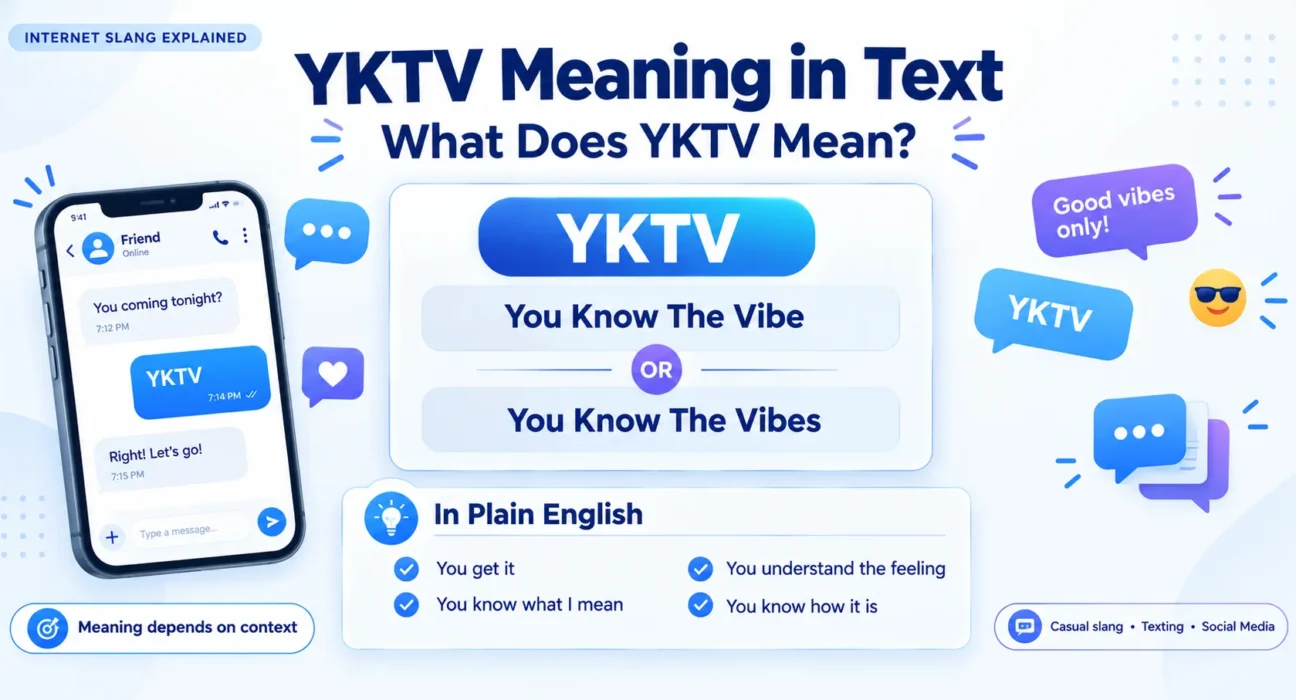
Most commonly, YKTV means “You Know The Vibe” or “You Know The Vibes.” In everyday conversation, it usually suggests that someone already understands the mood, situation, feeling, or shared experience without needing a long explanation.
If you are trying to figure out what someone meant by YKTV, the important part is not just the full form. The surrounding message can tell you whether the person is being friendly, playful, relatable, excited, or simply pointing to a shared understanding.
What Does YKTV Mean in Text?
YKTV usually means “You Know The Vibe” or “You Know The Vibes.”
People use it as a casual way to say that another person already understands what they mean. The “vibe” might refer to a mood, situation, inside reference, experience, or feeling that does not need much explanation.
For example:
“Late-night drive, good music, no plans. YKTV.”
Here, the person is not asking the reader to define a specific “vibe.” They are saying something closer to:
“You know exactly what I mean.”
Another example:
“That feeling when Friday finally comes… YKTV.”
The abbreviation adds a sense of shared understanding. It assumes the other person can relate to the situation or feeling being described.
YKTV Means “You Know The Vibe” or “You Know The Vibes”
You may see YKTV expanded in two closely related ways:
- You Know The Vibe
- You Know The Vibes
Both communicate essentially the same idea in casual slang.
The singular version focuses on a particular mood or feeling, while the plural version can sound more like a general reference to the overall energy or situation.
For example:
“This song at midnight… YKTV.”
This can mean:
“You know the vibe.”
Meanwhile:
“Weekend with the crew, good food, good music. YKTV.”
can suggest:
“You know the vibes.”
There is no need to treat one version as a completely different abbreviation. In informal online language, people may use either wording while keeping the same basic meaning.
What Does YKTV Mean in Plain English?
In plain English, YKTV is often similar to saying:
- “You know what I mean.”
- “You get it.”
- “You know how it is.”
- “You understand the feeling.”
- “You know the situation.”
The best interpretation depends on what comes before or after YKTV.
For example, imagine someone posts:
“No alarm tomorrow, favorite playlist on, and nowhere to be. YKTV.”
They are not simply stating that you know a literal “vibe.”
They are suggesting:
“You understand how good this feels.”
That is why translating YKTV word-for-word can miss the point. Its practical meaning comes from the shared feeling or context behind the message.
What Does YKTV Suggest in a Conversation?
YKTV usually suggests that the sender believes the other person can understand the situation without further explanation.
That shared understanding can come from different things.
Maybe you both experienced the same situation. Maybe you have the same taste in music. Maybe you understand an inside joke. Or maybe the mood is so familiar that the sender assumes you already get it.
For example:
“We stayed up until 3 a.m. talking about everything. YKTV.”
The message may suggest that the reader understands the kind of late-night conversation being described.
Another example:
“That first coffee after a long week… YKTV.”
Here, YKTV points toward a familiar feeling rather than a specific fact.
YKTV Can Point to a Shared Experience
Sometimes YKTV is used when the sender and reader have something in common.
For example:
“Beach, sunset, and your favorite people. YKTV.”
The sender expects the reader to understand the feeling or atmosphere being described.
YKTV Can Make a Message Feel More Casual
YKTV can also make a statement sound relaxed and conversational.
Instead of explaining every detail, the sender can use the abbreviation to imply:
“You already understand.”
This is one reason it works naturally in texts, captions, comments, and other informal communication.
Context Still Matters
YKTV does not automatically tell you exactly what emotion the sender has.
Consider this:
“You had to be there. YKTV.”
That could be playful or nostalgic.
But:
“Everyone was laughing and having a great time. YKTV.”
sounds more positive and upbeat.
The abbreviation stays similar, while the surrounding words change the message.
So if you are trying to interpret YKTV in a conversation, read the whole message, not just the four letters.
How Do People Use YKTV in Texting and Social Media?
YKTV is mainly useful in informal communication where people already understand internet slang.
You may see it in:
- text messages
- group chats
- social-media captions
- comments
- casual posts
- messages between friends
The purpose is usually the same: to point toward a mood, experience, situation, or feeling that the audience is expected to understand.
YKTV in Casual Text Messages
In a text conversation, YKTV can follow a statement about something relatable or enjoyable.
For example:
“Finally finished work. Favorite food, comfy clothes, and a movie. YKTV.”
The sender is basically saying:
“You know how good this feels.”
Another example:
“We need another road trip soon. YKTV.”
Here, the abbreviation reinforces the shared memory or experience between the people involved.
It can also appear in a short response:
“That playlist is perfect. YKTV.”
In this case, the sender is signaling that the other person understands the mood they are talking about.
YKTV in Captions and Comments
YKTV can also work as a short caption or comment when the image or situation already communicates most of the message.
For example:
“Summer nights with the best people. YKTV.”
Or:
“Good music. Good company. No complaints. YKTV.”
A person might also use it in a comment:
“This is exactly the vibe. YKTV 😂”
The surrounding content gives the abbreviation its context.
If a photo, video, song, or caption already creates a particular mood, YKTV can act as a quick way of saying that the audience understands it.
Where YKTV Works Best
YKTV works best when the conversation is casual and the people involved are comfortable with slang.
Good situations include:
- chatting with friends
- posting a casual caption
- commenting on a relatable post
- talking about a shared experience
- responding to a familiar mood or situation
For formal communication, it is usually clearer to write the idea in normal words.
For example, instead of:
“The meeting went exactly as expected. YKTV.”
a professional message would be clearer as:
“The meeting went about as expected.”
The main point is simple: YKTV is designed for casual communication, where shared context matters more than formal wording.
What Tone Does YKTV Have?
YKTV is usually casual, relaxed, and conversational. The exact tone depends on the message around it.
Someone might use YKTV to sound friendly when talking about a shared experience. For example:
“That late-night food run was everything. YKTV.”
Here, YKTV suggests that the other person understands the feeling.
It can also sound playful or confident:
“We already know where the party is tonight. YKTV 😂”
In some conversations, YKTV can have a slightly flirty tone. However, the abbreviation itself is not automatically romantic or sexual.
For example:
“You looked good tonight. YKTV.”
The surrounding conversation tells you whether the message is friendly, playful, flirty, or simply relatable.
YKTV Can Show Shared Understanding
The main idea behind YKTV is that the sender expects you to understand the reference, mood, or situation.
It can create a feeling of connection without explaining everything.
For example:
“That one song came on and suddenly we were back in college. YKTV.”
The sender assumes you share the same memory or feeling.
YKTV Can Be Playful or Lighthearted
People may also add YKTV after a funny or familiar situation.
“We said we were only staying for one drink. Three hours later… YKTV.”
The phrase adds a casual “you know how it goes” feeling.
Context Matters More Than the Acronym
Do not decide the tone from YKTV alone.
Look at the words before it, the relationship between the people, emojis, punctuation, and the overall conversation.
That context usually tells you what the sender really means.
How Do You Reply to YKTV?
The easiest way to reply to YKTV is to match the tone of the original message.
If the sender is talking about something you both understand, you can respond with a short agreement. You do not need to explain the abbreviation.
Casual Replies That Sound Natural
Here are some simple replies:
- “Exactly 😂”
- “For real.”
- “I know what you mean.”
- “You already know.”
- “Facts.”
- “Definitely.”
- “No doubt.”
- “That’s what I’m saying.”
- “Haha, exactly.”
- “We’re on the same page.”
For example:
Friend: “That place hits different at night. YKTV.”
You: “For real 😂”
The reply works because it keeps the same relaxed tone.
Another example:
Friend: “Nobody does late-night drives like us. YKTV.”
You: “You already know.”
Again, the response confirms that you understand the shared reference.
What If You Are Not Sure What They Mean?
You do not have to guess.
If the context is unclear, simply ask:
- “What do you mean by YKTV?”
- “Wait, what’s YKTV?”
- “You know the vibe?”
- “What vibe are you talking about? 😂”
- “I’m not following lol.”
A quick clarification is often better than giving a reply that does not fit the conversation.
If the message seems to use YKTV differently from the usual meaning, the surrounding words may provide the answer.
YKTV vs. IYKYK: What’s the Difference?
YKTV and IYKYK can feel similar because both can point to shared understanding.
However, they are not the same abbreviation.
YKTV usually means “You Know The Vibe” or “You Know The Vibes.”
IYKYK means “If You Know, You Know.”
The difference is mainly in what the sender is emphasizing.
| Abbreviation | Common meaning | Main idea |
|---|---|---|
| YKTV | You Know The Vibe / You Know The Vibes | You understand the mood or situation |
| IYKYK | If You Know, You Know | Only people familiar with the reference will understand |
For example:
“This song at midnight? YKTV.”
The sender is pointing to a particular mood or feeling.
Compare that with:
“What happened after the concert… IYKYK.”
Here, the sender is suggesting that people who experienced the situation will understand the reference.
Why They Can Sometimes Feel Similar
Both abbreviations can communicate an inside understanding.
That is why someone unfamiliar with internet slang may confuse them.
A useful shortcut is:
YKTV = You understand the vibe.
IYKYK = You understand if you already know the reference.
The exact tone still depends on the conversation.
Is YKTV Formal or Informal?
YKTV is informal slang.
It is most appropriate for casual conversations, social media posts, captions, comments, and messages between people who are comfortable using internet abbreviations.
You generally would not use YKTV in a professional email, formal application, academic assignment, business report, or official communication.
For example, this works in a casual text:
“That coffee spot is perfect for studying. YKTV.”
But a professional message would be clearer without the abbreviation:
“I think you understand the atmosphere and what I mean.”
When YKTV Fits
YKTV can work well in:
- Text messages
- Group chats
- Social media captions
- Comments
- Casual direct messages
- Conversations with friends
- Informal online communities
When to Avoid YKTV
Avoid it when the message needs to sound formal, precise, or professional.
That includes:
- Work emails
- Job applications
- School assignments
- Business proposals
- Customer-service messages
- Official documents
The issue is not that YKTV is inappropriate everywhere. It is simply too casual for situations where standard language is expected.
YKTV Meaning FAQ
What does YKTV stand for?
YKTV commonly stands for “You Know The Vibe” or “You Know The Vibes.” Both versions express a similar idea of shared understanding.
What does YKTV mean in texting?
In texting, YKTV usually means that the other person understands the mood, situation, feeling, or reference being discussed.
Is YKTV the same as “you know what I mean”?
Not exactly, but the meanings can overlap.
Depending on context, YKTV can communicate a similar idea to “you know what I mean,” “you get it,” or “you know how it is.”
Does YKTV mean “You Know The Vibes” or “You Know The Vibe”?
Both expansions are used.
The singular “You Know The Vibe” and plural “You Know The Vibes” are closely related, so context is more important than treating one version as the only correct expansion.
Is YKTV a rude word?
No. YKTV is not inherently rude.
Its tone depends on the surrounding message and the relationship between the people talking.
Can YKTV be flirty?
It can appear in a flirty conversation, but YKTV itself does not automatically mean something romantic or flirty.
The rest of the message provides the important context.
Can I use YKTV in a professional message?
It is better to avoid YKTV in professional communication.
Use clear, standard wording instead, especially when communicating with clients, employers, teachers, or colleagues.
What should I say when someone texts YKTV?
You can reply with something simple such as “Exactly,” “For real,” “You already know,” or “Facts.”
If you do not understand the context, ask the person what they mean.
Is YKTV the same as IYKYK?
No.
YKTV commonly means “You Know The Vibe” or “You Know The Vibes,” while IYKYK means “If You Know, You Know.”
They can express a similar sense of shared understanding, but they are used differently.
Does lowercase yktv mean something different?
Usually, no.
People often write slang abbreviations in lowercase when texting or posting online. yktv and YKTV generally refer to the same abbreviation.
Conclusion
YKTV usually means “You Know The Vibe” or “You Know The Vibes.” In everyday texting and social media, it points to a shared mood, situation, feeling, or understanding.
The exact meaning can shift slightly with context. Someone might use YKTV to say “you get it,” “you know how it is,” or simply “you understand the feeling.”
If you see YKTV in a casual message, look at the words around it before deciding what the sender means. The abbreviation itself is informal, so it works best in relaxed conversations rather than professional communication.
And if you are still unsure how to respond, you can always ask. Sometimes a simple “What do you mean?” is the most natural reply.