


Discharge Color Meanings: Complete Guide

If you are searching for discharge color meanings, you probably noticed a change and want a straight answer. Maybe your discharge looked yellowish this morning, or you spotted brown between periods, and now you are wondering whether it is normal or a reason to worry. That question is more common than you might think, and this guide answers it color by color in plain language.
You will learn what each discharge color usually means, which changes are typically harmless, and which ones deserve a call to your clinician. In addition, you will find out why color alone never gives the full answer, and what other clues to watch alongside it.
Are you staring at a color you have never seen before? Are you wondering whether yellow always means infection, or whether brown discharge is ever normal? Or are you trying to decide if what you are seeing can wait until your next checkup? This guide walks you through every major discharge color step by step, so you can read your body’s signals with confidence instead of fear.

Why Discharge Color Meanings Matter — But Never Tell the Whole Story
Discharge color meanings are a useful starting point because color is the first thing you notice. However, color is only one clue among several. Clinicians treat color together with odor, texture, timing in the menstrual cycle, and accompanying symptoms before drawing any conclusion. Therefore, think of this guide as a map, not a diagnosis.
Here is why the full picture matters more than any single shade. Two people can notice the exact same white discharge and have completely different things going on: one may be in the luteal phase of a healthy cycle, while the other may be developing a yeast infection. As a result, the guide below pairs every color with the extra clues that actually separate “probably normal” from “worth checking.” For instance, odor is often the strongest second signal — a mild scent is typical, while a strong fishy or foul odor points toward a problem more clearly than color alone. Similarly, texture tells its own story: stretchy and slippery is a classic ovulation sign, while thick and clumpy with itching often accompanies yeast overgrowth. Timing matters too, because clear, copious discharge around ovulation is expected, whereas unexplained brown spotting mid-cycle deserves attention. Keep these three companions — odor, texture, timing — in mind as you read each color below, and you will get far more from this guide than the colors alone could ever tell you. Finally, no article can diagnose you; only a clinician with proper testing can confirm what is happening.
What Normal Discharge Actually Looks Like (Your Personal Baseline)
Before judging any color, you need a baseline, because “normal” discharge varies widely from person to person. Healthy discharge is usually clear to milky white, with a mild or slightly sour scent and no itching, burning, or pain. Its amount and texture shift through the month as estrogen rises and falls: many people notice dry or sticky days right after a period, then wet, stretchy, egg-white-like discharge around ovulation, then thicker, creamier discharge before the next period. That pattern is completely ordinary.
In addition, several life stages and habits move the baseline without signaling trouble. During pregnancy, for example, increased thin, milky discharge (called leukorrhea) is one of the most common early changes. Breastfeeding, perimenopause, and hormonal contraception can also reduce or alter discharge. Because of all this variation, the single most useful habit is knowing your own normal. Pay attention for a cycle or two: which colors show up when, what your typical texture feels like, and what your usual scent is. Once that baseline is familiar, genuine changes stand out immediately, and you will read any discharge color guide with much sharper questions.
Discharge Color Meanings: The Complete Color-by-Color Guide
Below is the full color breakdown. For each color you will see what it looks like, what it often means, when it is usually normal, and when it deserves a clinician’s opinion. Remember the three companions — odor, texture, timing — as you go.
Clear or Transparent Discharge
Clear, watery discharge is one of the most normal things your body produces. It often increases around ovulation, when estrogen peaks and the cervix releases fertile-quality mucus, and it also appears with arousal. In general, clear discharge with no strong odor and no itching needs no action at all. However, if clear discharge becomes very heavy and watery — especially during pregnancy — or comes with burning, it is worth mentioning to a clinician, since irritation or (in pregnancy) leaking fluid can present this way.
White or Milky Discharge
White, creamy discharge is usually normal, especially in the second half of your cycle after ovulation. It tends to be thicker and cloudier just before your period, and a thin milky flow is also the hallmark of normal pregnancy discharge. On the other hand, watch the texture and feel: if the whiteness stays smooth, odorless, and itch-free, there is typically nothing to worry about. A sudden change in your usual white discharge — new odor, new itching, or a big jump in amount — is the moment to read on rather than assume it is fine.
Thick, Clumpy White Discharge (Cottage Cheese)
This one is distinctive: thick, white, clumpy discharge that looks like cottage cheese, often with itching, burning, or soreness. That combination is the classic picture of a vaginal yeast infection, an overgrowth of the Candida fungus that naturally lives in the vagina. Yeast infections are more likely after antibiotics, during pregnancy, or with uncontrolled blood sugar. Notably, the discharge in a yeast infection often smells mild or slightly yeasty rather than foul. Because several conditions can look similar, a first episode — or one that keeps returning — is best confirmed by a clinician rather than self-treated from a chart alone.
Pale Yellow Discharge
A faint yellow tint is not automatically alarming. Discharge can look pale yellow when it oxidizes on contact with air (the same reason underwear stains turn yellowish), and slightly yellow-tinged mucus can appear at the end of a period or in pregnancy. If the pale yellow is odorless, thin, and comes with no itching or burning, it usually falls within normal variation. That said, pay attention to what is new for you: a yellow tint you have never seen before, especially with a developing odor or pelvic discomfort, deserves a second look rather than being dismissed.
Bright Yellow Discharge
Bright or dark yellow discharge is a different story from a faint tint. When yellow turns vivid and comes with odor, chunky texture, or pelvic pain, it can signal a possible infection — including trichomoniasis or, in some cases, gonorrhea or chlamydia. It can also accompany bacterial vaginosis. Because bright yellow that is foul-smelling or paired with pain crosses from “variation” into “symptom,” this color belongs on your see-a-clinician list, particularly after unprotected sex or a new partner. Do not try to self-diagnose the exact infection from color alone; treatments differ, so proper testing matters.
Green Discharge
Green discharge is never considered a normal variation. A frothy or thick green discharge with odor, itching, or soreness is most often linked to trichomoniasis, a common and treatable infection, and it can also occur with gonorrhea or severe bacterial vaginosis. Sometimes the color sits between yellow and green, which still counts as abnormal. If you notice green discharge, the right move is straightforward: book a clinical evaluation and STI testing rather than waiting to see whether it clears on its own. These infections respond well to treatment, and earlier care prevents complications.
Gray Discharge
Thin, gray or grayish-white discharge with a fishy odor is the classic sign of bacterial vaginosis (BV), the most common cause of abnormal discharge in people of reproductive age. BV happens when the normal lactobacilli are replaced by other bacteria; it is not itself an STI, though it is more common with new or multiple partners and with douching. The fishy smell often becomes more noticeable after sex. Because BV raises the risk of catching STIs and of preterm birth in pregnancy, it needs proper diagnosis and antibiotic treatment — over-the-counter yeast treatments will not fix it.
Pink Discharge
Pink discharge is usually discharge lightly mixed with blood. It can appear around ovulation, after sex (from mild cervical irritation), or at the very start or end of a period. In early pregnancy, light pink spotting can also occur. Most of the time, brief pink spotting tied to an obvious moment like your cycle or intimacy is not concerning. However, pink discharge that is persistent, heavy, painful, or unrelated to your period — especially bleeding after menopause — should be evaluated by a clinician.
Brown Discharge
Brown almost always means old blood: blood that took longer to leave the body and oxidized along the way. It commonly appears at the beginning or end of a period and after sex. In early pregnancy, light brown spotting can be an early sign, though any bleeding in pregnancy should be mentioned to your provider. When brown discharge shows up repeatedly between periods, comes with odor or pelvic pain, or appears after menopause, it stops being “just old blood” and becomes a reason to get checked. A very foul-smelling brown or gray discharge can also signal a retained tampon, which needs prompt attention.
Red or Bloody Discharge
Red discharge during your period is, of course, normal menstruation. The question is red outside your period: light spotting can happen around ovulation or from cervical irritation, but bleeding between periods, after sex, or after menopause always warrants a clinical conversation. If bleeding is heavy enough to soak a pad or tampon quickly, lasts more than a day, or comes with cramping or pain, treat it as urgent. Persistent unexplained bleeding can occasionally signal polyps or, rarely, more serious cervical or uterine conditions — which is exactly why clinicians want to hear about it early.
Orange or Rust-Colored Discharge
Orange is uncommon and worth a careful look. It usually represents blood mixed with discharge, sometimes from an infection that irritates the cervix. A one-off orange tint right around your period may just be unusual spotting. But orange discharge that persists, smells bad, or comes with itching or pain should be evaluated — it is one of those colors where the combination of symptoms matters more than the shade itself.
Discharge Color Meanings During Pregnancy
Pregnancy changes discharge in ways that worry many expecting parents, so this section stands on its own. The headline fact: more discharge during pregnancy is normal. Rising estrogen and increased blood flow typically produce extra thin, milky-white, mild-smelling discharge from the very first weeks, and it often increases as pregnancy progresses.
The color rules shift slightly here. White, clear, and even pale yellow remain normal as long as there is no itching, strong odor, or burning. In contrast, green or bright yellow discharge, gray discharge with a fishy smell, or thick clumpy white discharge with itching should all be reported to your provider — infections are more common in pregnancy, and some carry risks such as preterm labor. Brown or pink spotting can be normal (implantation or cervical sensitivity), but any bleeding in pregnancy deserves a call to your provider or midwife, especially if it is heavy, lasts more than a day, or comes with cramping. One more warning sign: a sudden gush or continuous watery leak may be amniotic fluid rather than discharge and needs immediate assessment. For a deeper dive, the American Pregnancy Association’s guide to vaginal discharge during pregnancy covers normal versus abnormal patterns in detail.
What to Check Alongside the Color: Odor, Texture, and Timing
Color starts the conversation, but these three checks usually finish it. Run through them whenever a color puzzles you.
Odor
A mild, slightly sour or musky scent is normal — it comes from the vagina’s healthy acidic pH. The smells that change the picture are strong, new, or unpleasant: a fishy odor strongly suggests bacterial vaginosis, while a foul or rotten smell can accompany trichomoniasis or a retained tampon. Keep in mind that scent naturally varies with your cycle, sweat, and even diet, so compare against your own usual rather than an imagined ideal.
Texture and Amount
Texture often answers what color cannot. Stretchy, slippery, egg-white discharge points to ovulation; thin and watery is typical around your period or with arousal; thick and creamy is common before a period. The textures that raise flags are clumpy or cottage-cheese-like with itching (possible yeast infection) and frothy or foamy (possible trichomoniasis). Similarly, a sudden large increase in amount — or, less commonly, a sudden drop with dryness and itching — is worth noting, since amount changes reflect hormonal or infectious shifts.
Timing in Your Cycle
The same color can mean different things on different days. Clear and copious around mid-cycle is ovulation doing its job; the same clear flow right after your period may simply be the tail of menstruation. Brown at the start or end of bleeding is old blood; brown mid-cycle is spotting that deserves attention. Because context changes meaning, many clinicians find a simple one-line daily note (“day 14, clear and stretchy, no odor”) more useful than a single color snapshot.
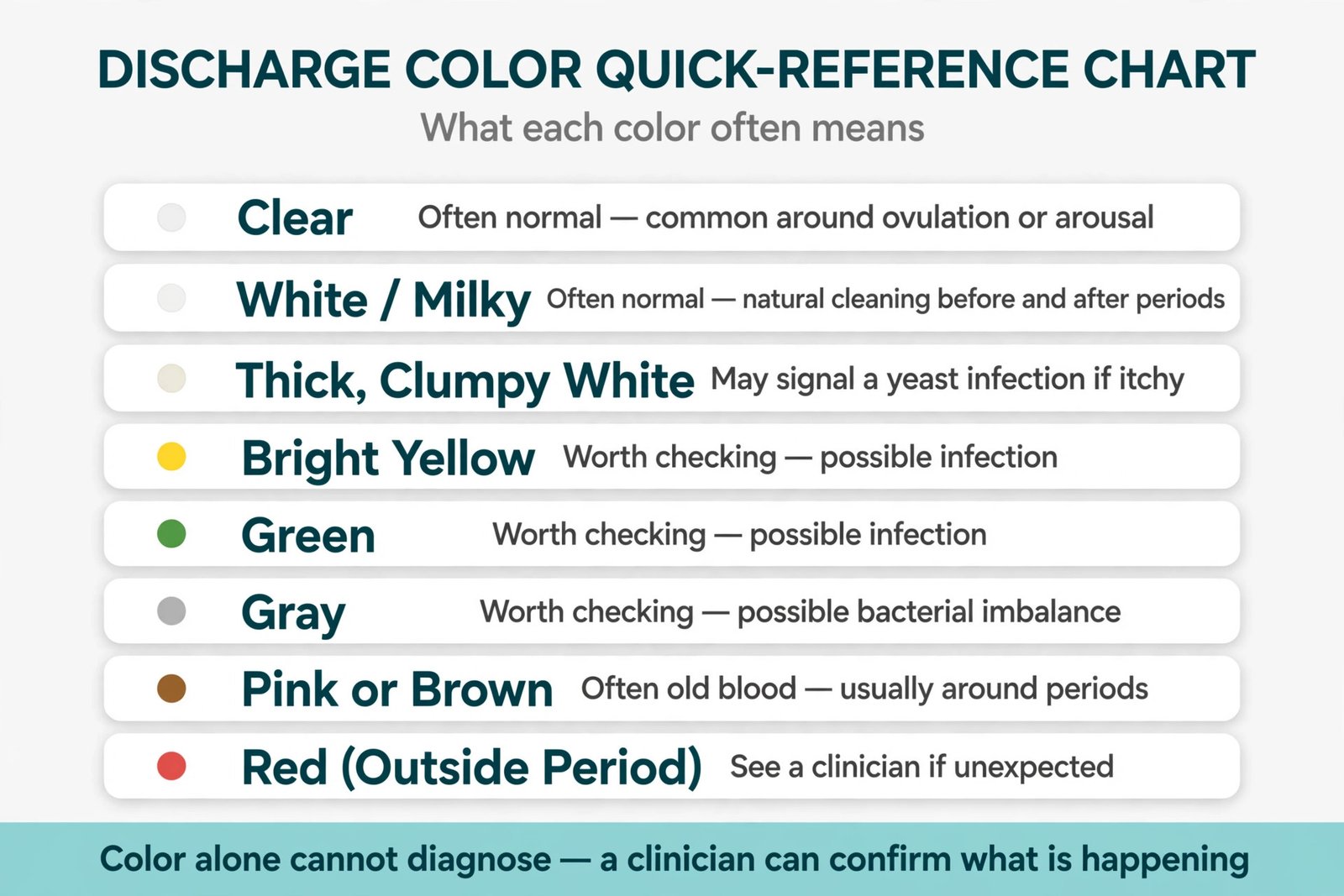
Discharge Color Meanings at a Glance: Quick-Reference Chart
Use this table as your fast lookup. It summarizes the discharge color meanings covered above, with the action each color usually calls for.
| Color | What it often means | What to do |
|---|---|---|
| Clear, watery | Ovulation, arousal — often normal | Nothing, unless watery and continuous in pregnancy |
| White, milky | Normal cycle or pregnancy discharge | Nothing if odorless and itch-free |
| Thick, clumpy white | Possible yeast infection if itchy | See a clinician, especially a first episode |
| Pale yellow | Oxidation, end of period — often normal | Monitor; check if odor or itching develops |
| Bright yellow | Possible infection | See a clinician |
| Green | Possible infection (e.g., trichomoniasis) | See a clinician; consider STI testing |
| Gray, fishy odor | Likely bacterial vaginosis | See a clinician for diagnosis and treatment |
| Pink | Light blood mixing — often around periods | See a clinician if persistent or painful |
| Brown | Old blood — usually around periods | See a clinician if between periods with odor or pain |
| Red (outside period) | Spotting or bleeding | See a clinician; urgent if heavy or with pain |
| Orange | Blood mixed with discharge | See a clinician if persistent or odorous |

Remember: this table reflects general patterns, not your diagnosis. When in doubt, a clinician’s test beats any chart.
When Discharge Color Means You Should See a Clinician

Put the chart aside and act if any of the following appear — regardless of color. Strong or fishy odor that is new for you; intense itching, burning, or swelling; pelvic pain, fever, or pain when urinating; green, gray, or bright yellow discharge; bleeding between periods or after menopause; or symptoms that do not improve or keep returning. These signs suggest infection, hormonal shifts, or other conditions that need proper testing, and earlier care almost always means simpler treatment.

If you are pregnant, lower your threshold further: report any green or yellow discharge, any strong odor, any bleeding, and any watery gush to your provider or midwife promptly. And one rule covers everyone — never try to diagnose and treat yourself from a color chart alone. A clinician can check vaginal pH, examine a sample under a microscope, and run lab tests that settle the question in minutes. That is the fastest path from worry to answers.
Frequently Asked Questions
Why does my discharge stain my underwear yellow?
This is one of the most common worries, and the answer is reassuring: it is usually chemistry, not infection. Healthy vaginal fluid is mildly acidic, and that acidity reacts with fabric dyes and bleaches them over time, leaving yellowish stains. As long as the discharge itself is clear to white, odorless, and itch-free, stained underwear alone is not a sign of infection.
Can stress or dehydration change discharge color?
Stress and mild dehydration do not directly turn discharge a new color. However, stress can disrupt your cycle timing, which shifts when each discharge type appears — so you may notice an unfamiliar texture or amount at an unexpected time. Dehydration can make mucus slightly thicker. If the color itself changes to yellow, green, or gray, look to infection or hormonal causes rather than your water intake.
Is it normal for discharge color to look different in the morning than in the evening?
Small day-to-day shifts are normal: discharge oxidizes on contact with air, so fluid that was clear when produced can look whiter or slightly yellow by the time you notice it. Arousal, exercise, and time since your last bathroom visit all nudge the appearance. What is not normal is a sudden, persistent change to green, gray, or bright yellow with odor or itching — that pattern does not come from the time of day.
Can discharge color alone tell me if I am pregnant?
No. Increased thin, milky-white discharge is a common early pregnancy change, but very similar discharge appears around ovulation and before periods in non-pregnant cycles. Discharge color cannot confirm pregnancy — only a pregnancy test (followed by a clinician’s confirmation) can. If your period is late and discharge has increased, take a test rather than reading the color.
What color should postpartum discharge (lochia) be?
After childbirth, vaginal bleeding called lochia follows a predictable sequence: bright or dark red for the first few days, then pinkish-brown, then yellowish-white over several weeks. This is normal healing, not menstrual discharge. Call your provider if lochia turns very heavy (soaking a pad hourly), develops a foul odor, or comes with fever or severe pain.
Conclusion
Searching for discharge color meanings usually starts with a moment of worry — an unfamiliar shade and a flood of questions. Now you have the map: clear and white are most often normal, pale yellow and brown usually trace back to oxidation or old blood, and bright yellow, green, and gray are the colors that merit a clinician’s visit. Just as importantly, you know that color is only one clue, and that odor, texture, and timing complete the picture.
The practical takeaway is simple. Learn your own baseline, note what changes, and act on the combinations that matter — new odor, itching, pain, or one of the warning colors. For more plain-language explanations, explore the meaning guides on quoteoffame.com whenever a new question comes up. Your body sends signals every day, and learning to read them calmly is a skill worth building. When a signal worries you, the bravest and smartest step is the same one every clinician recommends: ask a professional, get tested, and get clear answers — then get back to your day with one less worry.