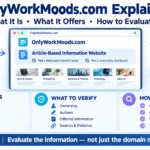


SimplifyDiggs com Explained: What It Is & How to Evaluate

If you searched for simplifydiggs.com, you are probably trying to understand more than just the name of a website. You may have reached SimplifyDiggs.com through a Google result and wondered what kind of site it is, what it actually publishes, and whether the information deserves your confidence.
Available search-indexed information describes SimplifyDiggs.com as a broad, general-interest publishing website rather than a specialized tool, app, or single-purpose service. Its apparent content covers areas such as technology, business, productivity, automotive topics, finance, travel, lifestyle, gaming, and other general-interest subjects.
What Is SimplifyDiggs.com?
SimplifyDiggs.com appears to operate as a multi-topic informational website. Instead of focusing on one subject such as technology, finance, cars, or travel, its content spans several unrelated categories.
That broad model explains why someone might discover the site through a search for a very specific topic and then wonder what kind of publication they have landed on.
The important point is that being a broad informational website does not automatically tell you whether a particular article is reliable. Website identity and content quality are two separate questions.
What Kind of Website Is It?
The available indexed material places SimplifyDiggs.com closer to a general-interest online publication or multi-topic blog than to a specialized professional resource. Articles associated with the domain cover different subject areas and are generally presented in an accessible, informational format.
This distinction matters because readers often use different websites for different purposes.
For example, you might use a general information site to get a quick explanation of an unfamiliar technology or to understand a new topic before researching it further. But if you need an exact technical specification, current regulation, medical recommendation, financial rule, or other consequential information, the appropriate authoritative source may be somewhere else.
So the most useful way to think about SimplifyDiggs.com is not simply “trusted” or “untrusted.”
Instead, ask:
What role is this particular article playing, and what evidence supports its claims?
That question becomes increasingly important because the site’s subject range is quite broad.
What Does SimplifyDiggs.com Publish?
One of the clearest characteristics associated with SimplifyDiggs.com is its wide content range.
Search-indexed material and current third-party reviews associate the site with topics including technology, business, productivity, automotive subjects, finance, travel, lifestyle, gaming, entertainment, health, and other general-interest areas.
That variety can be convenient for readers, but it also creates an important evaluation issue: expertise can vary from one subject to another.
A website that discusses many unrelated areas should not automatically be treated as though it has the same level of specialist expertise across every category.
Technology, Digital Tools, and Productivity
Technology-related material associated with SimplifyDiggs.com can cover digital tools, software, online services, emerging technologies, and productivity-related subjects.
For a reader, this type of content can be useful when the goal is to understand a concept in simple language or discover a topic for further research.
However, technology changes quickly.
If an article discusses a current software feature, subscription price, security setting, product specification, or platform policy, check the publication or update date. Then compare important details with the relevant company’s official documentation when accuracy matters.
An easy-to-read explanation can help you understand what something means without necessarily being the best source for what the official product currently does.
Business, Finance, Automotive, and Other Practical Topics
The site’s broader content footprint also includes business, finance, automotive, and practical-interest subjects.
These categories require different levels of verification.
For example, a general article explaining a business concept may be useful as an introduction. But an article discussing a financial rule, investment decision, tax requirement, loan condition, or current market information deserves confirmation from an appropriate authoritative source.
The same principle applies to automotive content. A general article can help a reader understand a vehicle, ownership topic, or feature, but exact specifications and current manufacturer information should be checked against official sources when the details matter.
In other words, topic coverage tells you what you may find on the website; it does not establish the authority of every article within that topic.
Lifestyle, Travel, Gaming, and General Information
SimplifyDiggs.com is also associated with broader lifestyle, travel, gaming, entertainment, and general-interest content.
These subjects can often be approached differently from high-stakes topics.
If you are casually exploring an idea, learning a basic concept, or looking for general information, a readable article may give you a useful starting point.
Travel is a good example of where the distinction becomes important.
An article may provide helpful background about a destination, but current entry requirements, visa rules, prices, opening hours, transport information, or travel restrictions can change. Those details should be confirmed through official or current sources before making plans.
The same principle applies across the site:
Use the article for the information it can reasonably provide, then verify details that could affect an important decision.
Why the Broad Topic Range Matters
At first, having many categories may seem like a benefit because it allows readers to explore different subjects from one website.
But it also creates a question that is more important than the number of categories:
Does the article demonstrate enough expertise and evidence for the specific subject it discusses?
That is something a category menu cannot answer.
A technology article, financial article, travel guide, and health article may require completely different standards of evidence. Treating all of them as equally authoritative simply because they appear on the same domain would be a mistake.
This is why the next step is not to judge SimplifyDiggs.com from its topic list alone. Instead, it is to examine what can actually be verified about the website and its editorial information.
That distinction will help separate observable facts from assumptions and make it easier to decide how much confidence to place in an individual article.
What Can Actually Be Verified About SimplifyDiggs.com?
When evaluating an unfamiliar website, it helps to separate what you can observe from what someone else claims about it.
Several recent third-party reviews describe SimplifyDiggs.com as a functioning multi-topic content website, but they also report difficulty independently confirming details such as ownership, editorial leadership, author credentials, and publishing policies. One review specifically notes that direct access to the site returned a 403 response during its review, limiting what could be independently checked from that review session.
That means readers should be careful with strong statements about who operates the website or how its editorial process works unless those details can be confirmed directly.
What Public Website Information Can Tell You
A website can reveal useful information through its visible pages, article bylines, publication dates, contact information, author profiles, policies, and disclosures.
These details can help answer basic questions such as:
- Is there a clearly identified publisher?
- Are individual articles attributed to authors?
- Do authors have useful biographies or credentials?
- Are articles dated?
- Are sources or references provided?
- Is sponsored or contributed content clearly identified?
- Is there a way to contact the publisher?
- Are corrections or editorial standards explained?
The absence of one particular page does not automatically prove that a website is unreliable. However, when several important transparency signals are difficult to verify, readers have less evidence with which to judge the publication.
This is why it is better to say “the ownership or editorial structure could not be independently confirmed” than to make an unsupported claim about who owns the site.
What About Ownership and Editorial Leadership?
Ownership is one of the areas where publicly available reviews raise questions about SimplifyDiggs.com.
Some reviewers report that they could not clearly identify a named owner, editorial team, or detailed About page from the information they were able to inspect.
That does not prove that no owner or operator exists. It means that the information was not sufficiently clear or independently verifiable in those reviews.
For readers, the practical lesson is simple: do not treat an unidentified website as an expert authority simply because its articles appear polished or rank in search results.
A transparent publication should make it reasonably possible to understand who is responsible for its content, particularly when it publishes information across areas where expertise matters.
Why a Working Website Does Not Automatically Prove Authority
A functioning website proves very little about the accuracy of its content.
A site can have:
- a professional-looking design,
- active pages,
- search-engine visibility,
- article categories,
- author names,
- advertisements,
- and regularly indexed content
without demonstrating specialist expertise.
Likewise, a website can publish a completely accurate article without having a famous brand or large editorial team.
The important distinction is between existence, usability, and authority.
A working website tells you that content is available. It does not, by itself, prove that every claim has been researched, fact-checked, tested, or reviewed by an appropriate expert.
Is SimplifyDiggs.com Safe to Browse?
Safety and reliability should be evaluated separately.
A website may be perfectly usable for reading while still requiring caution about the information it publishes. Conversely, a site can contain useful information while still asking readers to be careful with external links, downloads, forms, or requests for personal data.
Recent reviews generally frame the main concern around editorial trust and transparency, rather than presenting evidence that merely visiting the domain is inherently dangerous.
Still, normal web-safety habits are appropriate.
What HTTPS Can and Cannot Tell You
If your browser shows HTTPS or a padlock when visiting a website, it generally means the connection between your browser and the website is encrypted.
That is useful for protecting data while it travels between your browser and the site.
But HTTPS does not prove that:
- the publisher is trustworthy,
- the article is factually correct,
- the website is an expert authority,
- a product recommendation is unbiased,
- or every external link is safe.
This distinction is important because the padlock can sometimes create a false sense of confidence.
Think of HTTPS as a connection-security signal, not a content-quality certificate.
What to Check Before Sharing Personal Information
A general informational article usually does not require sensitive personal information.
Before entering an email address, password, payment details, identification information, or other personal data, ask why the website needs it and whether the request makes sense for the service being provided.
Also check:
- Where the form sends your information.
- Whether the page clearly explains what the data will be used for.
- Whether you actually need to submit the information.
- Whether your browser displays any security warning.
- Whether the request comes from the main website or an external service.
If a page unexpectedly asks for sensitive information, there is no reason to provide it simply because you were reading an article.
How to Handle External Links and Downloads
External links deserve the same level of attention as the page itself.
A link inside an article may lead to an official source, an advertiser, an affiliate destination, another publication, a software download, or an unrelated third-party website.
Before clicking an unfamiliar link, look at its destination and consider whether it matches the context of the article.
Be particularly careful with unexpected downloads, executable files, browser extensions, password requests, or payment pages.
A useful rule is:
Read the article first; investigate the destination before interacting with it.
Can You Trust a SimplifyDiggs.com Article?
The most useful answer is: evaluate the individual article rather than trusting or rejecting the entire domain automatically.
Third-party reviews have raised concerns about author transparency, sourcing, ownership information, and editorial depth. At the same time, those reviews do not establish that every article on the site is inaccurate.
The better approach is to inspect the evidence behind the specific information you want to use.
Check the Author and Expertise
Start with the byline.
Ask:
- Is a real author identified?
- Is there an author profile?
- Does the profile explain relevant experience?
- Does the author’s background match the subject?
- Is the article written as personal experience, general information, or expert advice?
A byline alone is not proof of expertise.
For example, someone writing about a general travel destination does not necessarily need professional credentials. But an article making medical, legal, financial, engineering, or cybersecurity claims deserves a higher standard of subject knowledge.
Check the Publication or Update Date
Dates matter because information changes.
Software features can change. Prices change. Regulations change. Travel requirements change. Vehicle specifications can vary by model year. Financial information can become outdated quickly.
Before relying on an article, check when it was published or updated.
An older article is not automatically wrong, but the older it is, the more important it becomes to confirm time-sensitive details elsewhere.
Look for Sources and Supporting Evidence
Strong informational content gives readers a way to verify important claims.
Depending on the topic, useful evidence may include:
- official documentation,
- government sources,
- research papers,
- manufacturer information,
- direct statements from organizations,
- reputable industry publications,
- testing results,
- data,
- or clearly explained firsthand experience.
If an article makes a specific claim but gives you no way to check where that claim came from, treat it as information to investigate rather than information to accept automatically.
Watch for Promotional or Sponsored Content
Commercial relationships do not automatically make an article false.
Websites can legitimately earn money through advertising, affiliate links, sponsored content, partnerships, or contributed articles.
The important issue is transparency.
Recent reviews have reported promotional or guest-post-related signals around SimplifyDiggs.com, although the precise commercial arrangements are not independently established by those reports.
If an article strongly promotes a particular company, product, service, dealership, or commercial destination, ask whether the relationship is disclosed and whether the claims are supported independently.
Verify Important Claims With Primary Sources
For important information, go one step closer to the original source.
If an article discusses a software feature, check the software company’s documentation.
If it discusses a government rule, check the relevant government website.
If it discusses a vehicle specification, check the manufacturer’s information.
If it discusses financial or tax requirements, check the appropriate official authority.
If it discusses medical information, consult an appropriate medical organization or qualified professional.
This does not make SimplifyDiggs.com useless. It simply puts the article in the right role: a possible starting point rather than the final authority.
Quick Article Trust Check
Before relying on a SimplifyDiggs.com article, run through this short checklist:
Author → Date → Sources → Evidence → Purpose → Verification
If most of those signals are clear, you have more reason to investigate the article further.
If several are missing, especially for a high-stakes topic, look for a stronger source before acting on the information.
When Should You Use Another Source?
There is no reason to use one website for every kind of question.
A general-interest publication may be useful for discovering a topic or understanding basic concepts. But certain subjects deserve information from sources with direct responsibility, specialist expertise, or primary documentation.
Health and Medical Information
Health information deserves particular caution because inaccurate advice can have real consequences.
For symptoms, diagnoses, medications, treatment decisions, or other medical questions, use qualified healthcare professionals and authoritative medical sources rather than relying on a general-interest article alone.
A general article may help you understand terminology, but it should not replace professional medical guidance.
Finance, Money, and Taxes
Financial information can become outdated quickly and may depend on your country, situation, or specific financial product.
For tax rules, regulatory requirements, investment decisions, lending conditions, or other consequential financial matters, verify the information through relevant government agencies, financial institutions, regulators, or qualified professionals.
A general explainer can provide context, but the final decision should be based on current and authoritative information.
Legal and Regulatory Questions
Laws and regulations are especially unsuitable for blind reliance on a general blog.
Rules can vary by jurisdiction and change over time.
If an article discusses a legal requirement, licensing rule, immigration requirement, contract issue, regulatory obligation, or similar matter, confirm it with the appropriate government or legal authority.
Security, Software, and Technical Decisions
Technology is another area where outdated information can cause problems.
For software configuration, cybersecurity, product specifications, APIs, account policies, pricing, or technical requirements, official documentation should normally be your first verification point.
A general article can make a complicated subject easier to understand, but official documentation tells you what the product or service actually supports at that time.
FAQ
Is SimplifyDiggs.com a blog or a service?
Available information indicates that SimplifyDiggs.com functions primarily as a general informational publishing website rather than a specialized software tool or single-purpose service.
Does a Google result mean a SimplifyDiggs.com article is reliable?
No. Search visibility and editorial reliability are different things. A search result tells you that a page was surfaced for your query; it does not independently verify every claim on that page.
Should I trust every article on SimplifyDiggs.com equally?
No. Evaluate each article based on its author, date, evidence, sources, purpose, and the importance of the decision you are making.
Why is verification important for a multi-topic website?
Different subjects require different kinds of expertise. A general article about a hobby may need less scrutiny than information about medicine, finance, law, cybersecurity, or a major purchase.
What is the biggest thing to check before relying on an article?
Look for evidence you can independently verify. A clear author, current date, credible sources, and supporting evidence give you much more to evaluate than a polished design alone.
Conclusion
If you searched for simplifydiggs com because you wanted to know whether the website is worth using, the most balanced answer is not simply “yes” or “no.”
SimplifyDiggs.com appears to be a functioning general-information publication with content across many subjects. However, available third-party reviews raise questions about how clearly its ownership, authorship, editorial standards, sourcing, and commercial relationships can be verified.
That does not automatically make the website fraudulent or every article unreliable.
The smarter approach is to judge the article, not just the domain.
For casual reading or an introduction to a subject, an accessible article may be useful. When the information could affect your health, money, legal position, security, travel plans, or an expensive purchase, verify the important claims through official, primary, or specialist sources.
The key lesson is simple:
A website can be useful without being your final authority.
Use SimplifyDiggs.com to discover and understand information when appropriate, but match your level of trust to the evidence available for the specific article.