





How to Start Your Day With a Smile (Even on Hard Mornings)
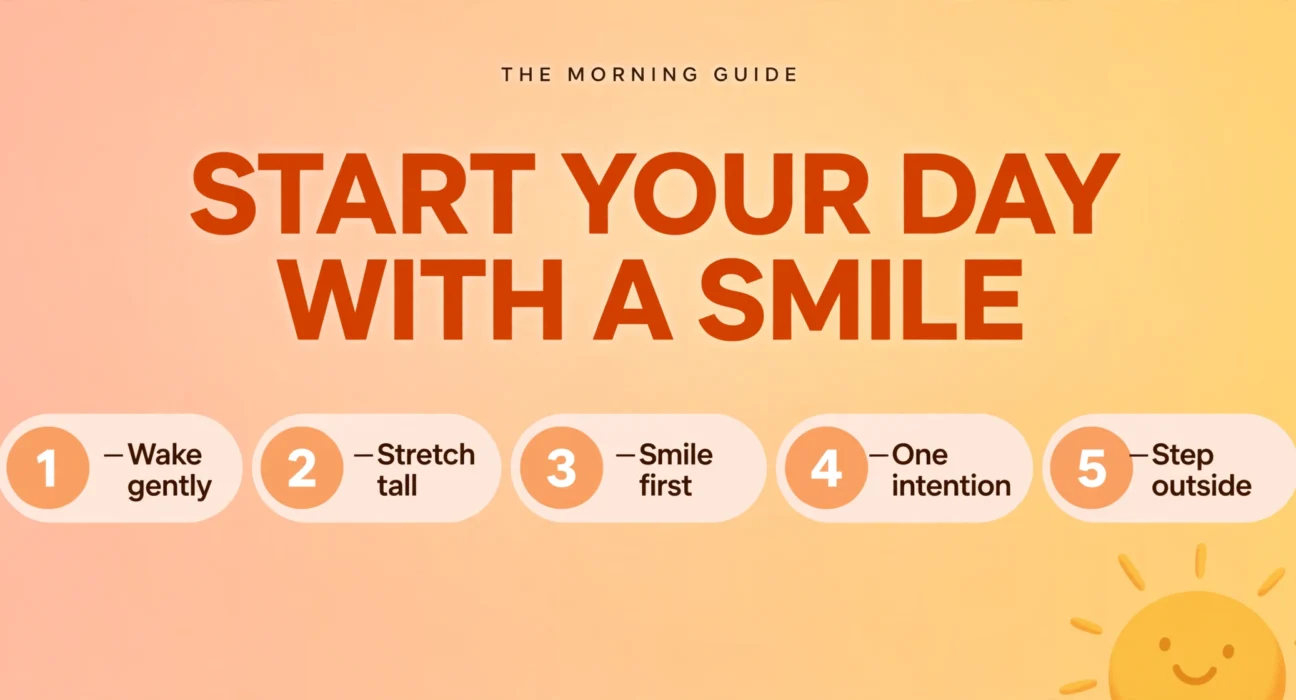
If you want to start your day with a smile, you do not need a perfect life, a quiet house, or an extra hour in bed. You need a small, repeatable sequence that tells your brain the day is safe to enjoy. Most people get this backwards: they wait to feel happy before they smile, and consequently the smile never arrives. The research, however, points the other way — the smile can come first, and the feeling often follows.
This guide gives you a practical system, not just motivation. You will learn a 5-minute routine that works on busy weekdays, ten small habits that make smiling easier over time, what to do on mornings that are genuinely hard, and the actual science behind why smiling shifts your mood. In addition, you will find a collection of smile quotes to borrow on the days your own optimism is running low.
Why Your Morning Mood Shapes the Whole Day
The first hour after waking carries unusual weight. During this window, your brain is deciding, largely below your awareness, what kind of day this will be. Cortisol — the alertness hormone — naturally peaks within 30 to 45 minutes of waking. This is called the cortisol awakening response, and it exists to mobilize you for the day. However, the same surge can feel like anxiety if your first inputs are stressful: alarming news, an overflowing inbox, or an argument before coffee.
In other words, your morning is not neutral ground. It is the control room. Small inputs here get amplified across the next sixteen hours. A calm, deliberate first few minutes therefore buys you emotional stability that no amount of afternoon willpower can fully replace. Moreover, mornings are one of the few parts of the day you can actually design — before other people’s demands arrive.
This is precisely why learning to start your day with a smile matters more than any single productivity hack. A smile at 7 a.m. is not about pretending everything is fine. Rather, it is a signal — to your nervous system and to the people around you — that you are choosing engagement over dread. And as you will see below, that signal changes things.
How to Start Your Day With a Smile in 5 Minutes
Five minutes is short enough that no schedule can defeat it, yet long enough to change your state completely. The routine below is designed to be done in order, without your phone, and without any special equipment. First, silence is part of the method — notifications can wait five minutes.
The First 60 Seconds
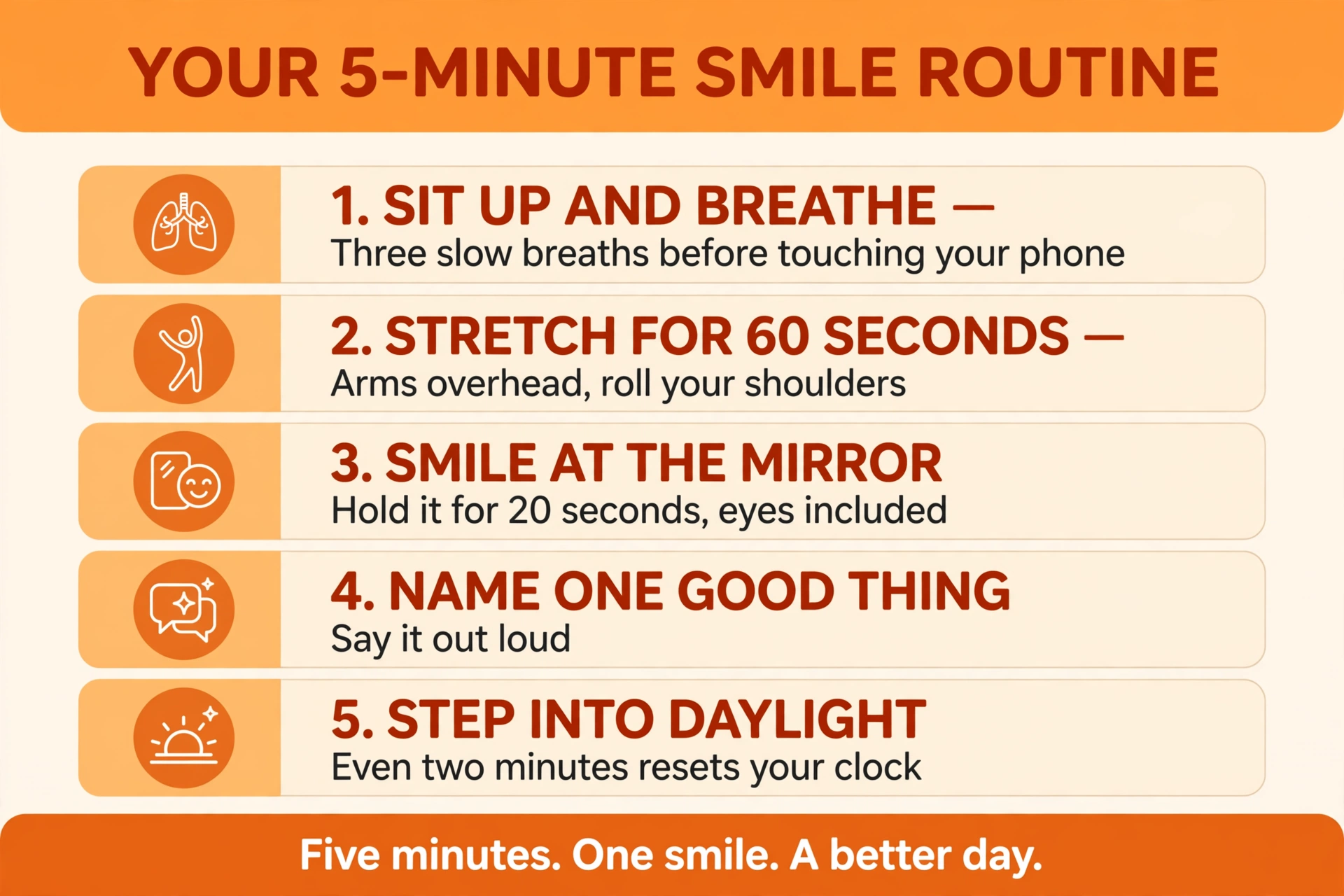
Sit up before you do anything else. Plant both feet on the floor and take three slow breaths: in through the nose for four counts, out through the mouth for six. This longer exhale activates the parasympathetic nervous system, which is the branch responsible for calm. As a result, your heart rate settles before the day has even begun.
Next, while you are still sitting, smile — deliberately and fully. Not a polite half-smile, but a real one that reaches your eyes. Hold it for twenty seconds. It will feel strange at first, and that is completely normal. The strangeness fades within days, while the effect compounds. Indeed, this single step is the hinge of the entire routine.
Minutes 2 to 5
Stand up and stretch tall for sixty seconds. Reach your arms overhead, roll your shoulders back, and open your chest. Your posture speaks to your brain constantly; an open, upright posture is consistently associated with more positive affect, while a collapsed one reinforces low mood. Therefore, this minute is not exercise — it is communication with your nervous system.
Then, name one good thing out loud. It can be tiny: hot water, a text from a friend, the fact that it is Friday. Saying it aloud matters because hearing your own voice state something positive makes it concrete in a way that silent thought does not. Finally, step into daylight — even just to a window — for the remaining time. Morning light is the strongest signal for your circadian clock, and consequently it improves both daytime alertness and nighttime sleep.
10 Small Habits That Make Smiling Easier
A routine handles the morning; habits handle everything the routine cannot reach. The ten habits below are deliberately small. Each one takes under two minutes, and together they build an environment where smiling becomes the path of least resistance rather than an act of willpower.
Habits for Your Body
1. Drink water before caffeine. After seven or eight hours without fluids, you wake up mildly dehydrated, and even mild dehydration measurably worsens mood and concentration. A full glass of water first therefore removes a hidden drag on your morning.
2. Move for two minutes. You do not need a workout. March in place, do ten squats, or walk briskly to the end of the street. Short movement releases endorphins and burns off the restless edge of morning cortisol. Moreover, it gives your smile something genuine to ride on.
3. Eat something with protein. Blood sugar crashes masquerade as bad moods. A breakfast with protein — eggs, yogurt, nuts — keeps your energy steady through the late morning, while a pure-sugar start sets you up for an 11 a.m. slump.
4. Get daylight within an hour of waking. If you cannot get outside, sit near the brightest window you have. Light suppresses melatonin and sharpens alertness. In darker months, a light-therapy lamp used during breakfast achieves much of the same effect.
Habits for Your Mind
5. Write three lines in a notebook. Not a journal entry — just three lines about what today could hold. This tiny act of authorship shifts you from reactive to intentional. For example: “Finish the report. Call Mom. Walk at lunch.” Small, concrete, yours.
6. Decide your one intention. Ask yourself: “What is one thing that would make today feel worthwhile?” Then say it as a sentence. An intention is not a to-do list; it is a compass. On chaotic days, it gives you one fixed point to return to.
7. Limit the first scroll. Give yourself a rule: no feeds until the routine is done. Social comparison is hardest to resist when your brain is still booting up, and fifteen minutes of other people’s highlight reels can quietly set a tone of inadequacy before your own day starts. Instead, let your first inputs be chosen, not fed to you.
Habits for Your Space
8. Make the bed. It takes ninety seconds and delivers the day’s first completed task. In addition, returning to a made bed in the evening extends the morning’s sense of order all the way to night.
9. Open a window. Fresh air and outside sound break the sealed-box feeling of indoor mornings. Even in winter, sixty seconds of cold air on your face is a powerful wake-up signal — sharper, in fact, than a second cup of coffee.
10. Put one thing where it belongs. Keys on the hook, shoes by the door, bag packed. Morning friction — hunting for things while the clock ticks — is a reliable smile-killer. Removing even one friction point therefore pays off daily.
What to Do on Mornings That Are Genuinely Hard
Some mornings, the advice above will feel absurd. Grief, illness, money fear, a sick child, the aftermath of terrible news — on these mornings, “just smile” is not merely unhelpful, it can feel insulting. So let us be honest: this section is not about forcing happiness. It is about surviving the morning with as little additional damage as possible.
Getting Through the Next Hour
First, lower the bar to the floor. On a hard morning, success is getting upright, drinking water, and breathing. That is the entire routine. Everything else is optional, and giving yourself explicit permission to skip it is itself a kindness. Paradoxically, this permission often makes the small steps feel possible again.
Second, borrow structure from outside yourself. When your own motivation is gone, external scaffolding carries you: a shower you take because it is simply what you do, a walk around the block because the dog needs it, breakfast because someone else is eating too. Do not wait to feel like doing these things. Instead, let the structure do the deciding.
Third, allow the smile to be aspirational rather than actual. Place your hand on your chest, breathe slowly, and think of one person who would want this morning to be gentler for you. That is enough. Research on self-compassion consistently shows that treating yourself with the kindness you would offer a friend reduces the intensity of distress. In other words, you do not have to earn gentleness by feeling better first.
When It Is More Than a Hard Morning
Finally, know the difference between a hard morning and a hard season. A hard morning passes; a hard season — persistent low mood, lost appetite, weeks of dread — deserves professional support, not a blog post. If mornings have been dark for more than two weeks, speaking with a counselor or doctor is the bravest and most practical step available. There is no shame in it, and consequently no reason to delay it.
The Science Behind Smiling and Mood
The idea that smiling can change how you feel is called the facial feedback hypothesis, and it has been debated by psychologists for over a century. The core claim is simple: facial expressions do not merely display emotions — they also feed back into them, nudging the feeling itself.
What does the evidence actually say? A 2019 meta-analysis combining 138 studies and more than 11,000 participants found that facial expressions have a small but real effect on feelings: smiling makes people feel happier, scowling makes them feel angrier, and frowning makes them feel sadder. The researchers were careful to add that nobody can simply smile their way to happiness — the effect is modest, not magical. You can read a summary of the research background in the facial feedback hypothesis overview.
A later global experiment, the Many Smiles Collaboration, tested nearly 4,000 participants across 19 countries and published its results in Nature Human Behaviour. It found that deliberately posing a smile produced a small but consistent lift in reported happiness, particularly when participants mimicked smiling faces or engaged their own smile muscles with awareness. The well-known “pen-in-mouth” trick, meanwhile, showed little effect — suggesting that genuine, intentional smiling matters more than mechanical mouth shapes.
The honest takeaway, therefore, is balanced. Smiling is not a cure for anything, and the effect sizes are small. However, small effects applied every single morning compound. A two-percent lift in mood, repeated across hundreds of mornings, changes the texture of a life. That is the real promise here — not transformation in a day, but a gentle, persistent tilt toward the light.
15 Smile Quotes to Start Your Day With a Smile
On the mornings when your own words fail, borrow someone else’s. Keep two or three of these where you will see them — on the bathroom mirror, as a phone wallpaper, or taped inside a kitchen cabinet. Read one aloud with your morning smile; hearing the words in your own voice doubles their effect.
Quotes on Smiling First
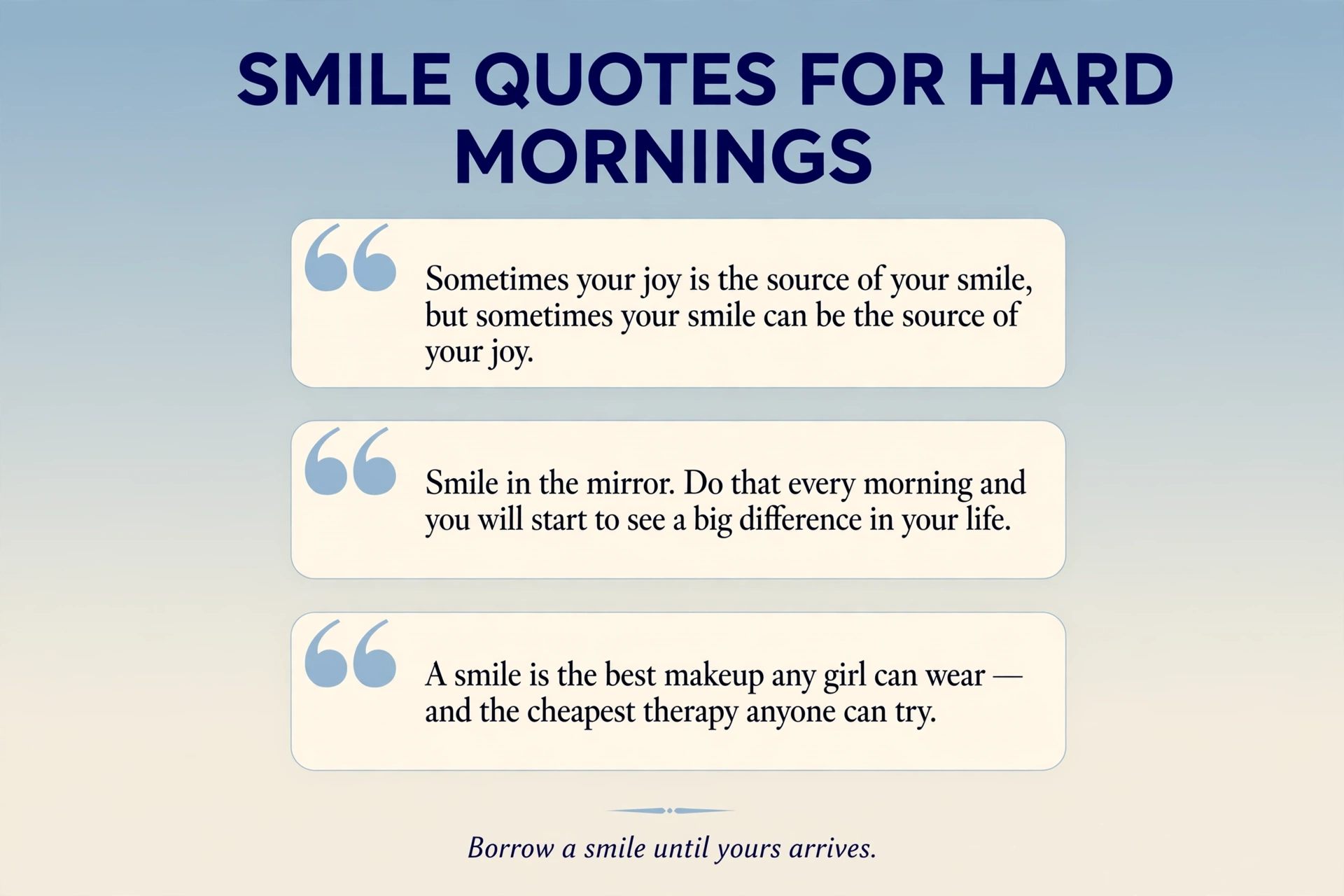
- “Sometimes your joy is the source of your smile, but sometimes your smile can be the source of your joy.” — Thich Nhat Hanh
- “Smile in the mirror. Do that every morning and you will start to see a big difference in your life.” — Yoko Ono
- “A smile is the best makeup any girl can wear.” — Marilyn Monroe
- “Every morning, when you wake up, you have energy, you have breath, you have a new day. That is enough to smile about.” — Adapted from a Buddhist saying
- “The robbed that smiles, steals something from the thief.” — William Shakespeare
Quotes for the Hard Mornings
- “Smile, it is the key that fits the lock of everybody’s heart.” — Anthony J. D’Angelo
- “A warm smile is the universal language of kindness.” — William Arthur Ward
- “Let your smile change the world, but don’t let the world change your smile.” — Connor Franta
- “Nothing you wear is more important than your smile.” — Connie Stevens
- “Smile at the obstacle, for it is a bridge.” — Medusa (band saying)
Quotes on Joy That Lasts
- “Wrinkles should merely indicate where smiles have been.” — Mark Twain
- “A smile costs nothing, but gives much.” — Anonymous
- “Peace begins with a smile.” — Mother Teresa
- “Smile at strangers and you just might change a life.” — Steve Maraboli
- “Today, give a stranger one of your smiles. It might be the only sunshine he sees all day.” — H. Jackson Brown Jr.
Choose the two that land hardest for you, and make them part of the routine. A quote on the mirror turns a private moment into a small ritual — and rituals, as psychologists note, are what turn intentions into identity.
Build Your Own Morning Smile Routine
The routines above are starting points, not commandments. The best morning routine is the one you will actually do on a rainy Tuesday when you slept badly. Consequently, the final step is to design yours deliberately, in about ten minutes, once.
Start by picking a wake-up anchor — something you already do every morning without thinking, like turning off the alarm or starting the kettle. Attach your first new habit to that anchor: “After I turn off the alarm, I sit up and take three breaths.” Habit research calls this implementation intention, and it works because the existing behavior triggers the new one automatically.
Next, choose exactly three elements from this guide — no more. Perhaps the mirror smile, the one good thing, and daylight. Write them on a card and place it where your morning happens. For the first week, do only those three. Then, if you like, add a fourth. Small commitments kept are worth more than ambitious plans abandoned; indeed, consistency is the entire mechanism.
Finally, review after two weeks. Ask: which of the three actually happened most days? Keep those. Drop or swap the rest without guilt. A routine is a tool, not a test. The goal was never perfection — it was simply to start your day with a smile more often than before, and to have a system that survives real life.
FAQs About How to Start Your Day With a Smile
Does smiling in the morning really improve your mood? Research suggests a small but real effect. A large meta-analysis found that posing a smile produces a modest lift in happiness, especially when done deliberately. It will not fix grief or depression, but as part of a morning routine, it consistently nudges mood in a better direction.
What if I wake up angry or anxious? Do not try to smile over the feeling. First, name it silently: “I am anxious about the meeting.” Naming an emotion reduces its intensity — a finding replicated across many studies. Then do the breathing step from the 5-minute routine. The smile comes last, once your nervous system has settled slightly.
How long does it take for a morning routine to become a habit? Studies on habit formation suggest a wide range — anywhere from three weeks to several months depending on complexity. However, simple anchored routines like the 5-minute sequence above typically feel automatic within three to four weeks of daily practice.
Can I start your day with a smile routine if I work night shifts? Absolutely. The principles are the same; only the clock changes. Do the routine at your “morning” — whenever you wake for your main stretch of the day — and get bright light at that time to anchor your body clock.
What is the single most important step if I only have one minute? The mirror smile combined with three slow breaths. It takes sixty seconds, requires nothing, and delivers both the physiological calm of slow breathing and the facial-feedback lift of smiling. Everything else is enhancement.
A Final Thought
You do not need to overhaul your life to change your mornings. You need five minutes, a mirror, and the willingness to smile before you feel like it. Some days the smile will feel genuine within seconds; on other days it will feel like an act of quiet defiance. Both count.
Start tomorrow. Not Monday, not next month — tomorrow. Sit up, breathe, stretch, smile, name one good thing, and step into the light. Then do it again the day after. Within weeks, you will have built something no bad news cycle can take from you: a morning that belongs to you.
If this guide helped, explore more practical wisdom and uplifting collections at Quote of Fame — new guides on living well, one small habit at a time.